AI Readiness Program 2026: The 8-Week Roadmap
How we turn overwhelmed ops into AI-native systems in 8 weeks.
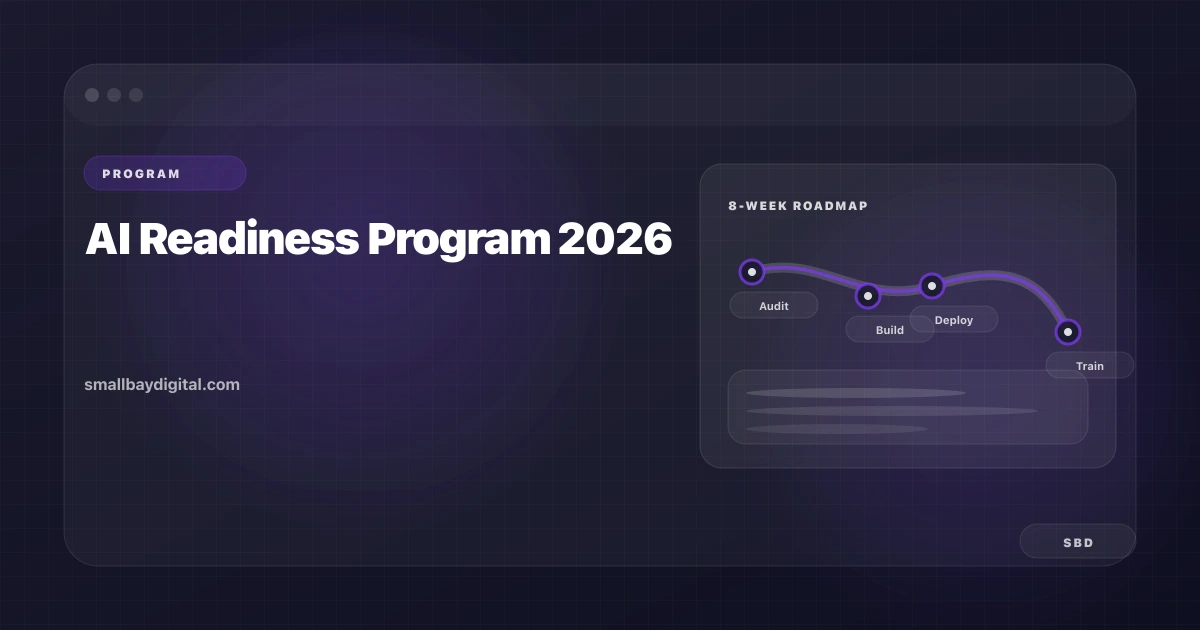

Table of Contents
Why this program exists
Most SMBs are juggling tools without systems. Teams are stuck in manual work while opportunities slip. The AI Readiness Program fixes that by turning your workflows into durable, scalable systems — in 8 weeks, not 8 months.
We built this program after seeing the same pattern over and over: companies buy AI tools, plug them in without a plan, and end up with more complexity than they started with. The tools aren’t the problem. The missing system underneath them is.
Who is this for?
B2B companies doing $1M-$20M in revenue with 5-50 employees, who have outgrown spreadsheets and basic automations but aren't ready for a $200k enterprise platform. You know AI should help — you just need someone to wire it into how your team actually works.
What happens in 8 weeks
Weeks 1–2: Deep Audit
We don’t start by building. We start by watching.
We map your actual processes — not the ones in your onboarding doc, the ones your team runs every day. That means sitting in on standups, following a ticket from creation to close, and asking uncomfortable questions about where things break.
Deliverables:
- Full process map of your core workflows (sales, ops, finance, support)
- Bottleneck identification with time/cost estimates for each
- Tool audit: what you’re paying for, what you’re actually using, and what’s redundant
- ROI model: which automations pay back fastest
Weeks 3–6: Infrastructure Build
This is where things get built. Based on the audit, we design and deploy systems — not just automations.
What gets built depends on your audit, but common outputs include:
- A central operations database (usually Airtable or SmartSuite) replacing the 12 spreadsheets your team maintains
- Automated workflows via Make.com or n8n that handle lead routing, ticket assignment, invoice generation, or status updates
- AI agents for tasks like email classification, data extraction from PDFs, or customer support triage
- Dashboards and internal portals (Retool or Softr) so your team can see what’s happening without asking someone
We build in 2-week sprints. You see working systems by week 4, not week 8.
Weeks 7–8: Handover & Training
Systems are only useful if your team runs them. We don’t just hand over a login.
Deliverables:
- Playbooks for every system we built — written for ops people, not developers
- Live training sessions with the team members who’ll use the tools daily
- Monitoring dashboards so you know when something needs attention
- 30-day post-handover support window for tweaks and questions
What makes this different from hiring a freelancer
A freelancer builds what you ask for. We figure out what you should be asking for.
The audit phase is the difference. Most companies think they need “a chatbot” or “a Zapier expert.” After the audit, they realize they need a lead-to-close system, or an ops dashboard, or an automated reporting pipeline. The specific tools are just implementation details.
We also stick around. The 30-day support window after handover means we’re available when your team hits edge cases in production — not just in a demo.
Real outcomes from past cohorts
- A manufacturing company cut order processing time by 45% and stopped losing dispatch updates between shifts
- A D2C brand went from 3 hours of manual product updates per day to zero — with automatic sync across 3 sales channels
- An agency scaled from 10 to 50 clients without adding ops headcount
- A building materials supplier automated their entire enquiry-to-invoice flow, including WhatsApp notifications to 5 stakeholder types
These aren’t hypotheticals. They’re case studies you can read.
Who it’s for
- SMB owners and operators who want time back but don’t want to hire a CTO
- Teams drowning in manual work — copying data between tools, compiling reports, chasing updates
- Companies that tried AI tools but couldn’t make them stick because the underlying processes were broken
- Ops leaders who know what needs to happen but don’t have the technical bandwidth to build it
Who it’s NOT for
- Companies with no existing processes (you need something to automate — we can’t automate chaos)
- Teams looking for a chatbot demo or an AI “proof of concept” with no ops intent
- Businesses unwilling to change how they work (the system only works if the team uses it)
How to apply
The program runs in limited cohorts. We cap each round at 5 companies so each one gets hands-on attention.
If this sounds like the right path, apply for the next cohort or book a call to discuss fit.
Related reads:
- The 2026 AI Readiness Checklist — Take this 10-point audit before you apply.
- Real case studies from our clients — See what AI-ready companies built with SBD.
- Our full service breakdown — From strategy to implementation and ongoing support.
Ready to implement this?
If you see your own systems in this article, let's talk. We can audit your current setup and build a roadmap.