







A post on X this year put it bluntly: Zapier is worth five billion dollars and is about to be worth nothing, because AI agents use software like humans. They click buttons, read screens, fill in forms and call APIs. They do not need integrations. They are the middleman.
It got a lot of agreement. We build agents for a living, and we also run Zapier and n8n in most client systems, so we have a view from inside.
The short answer
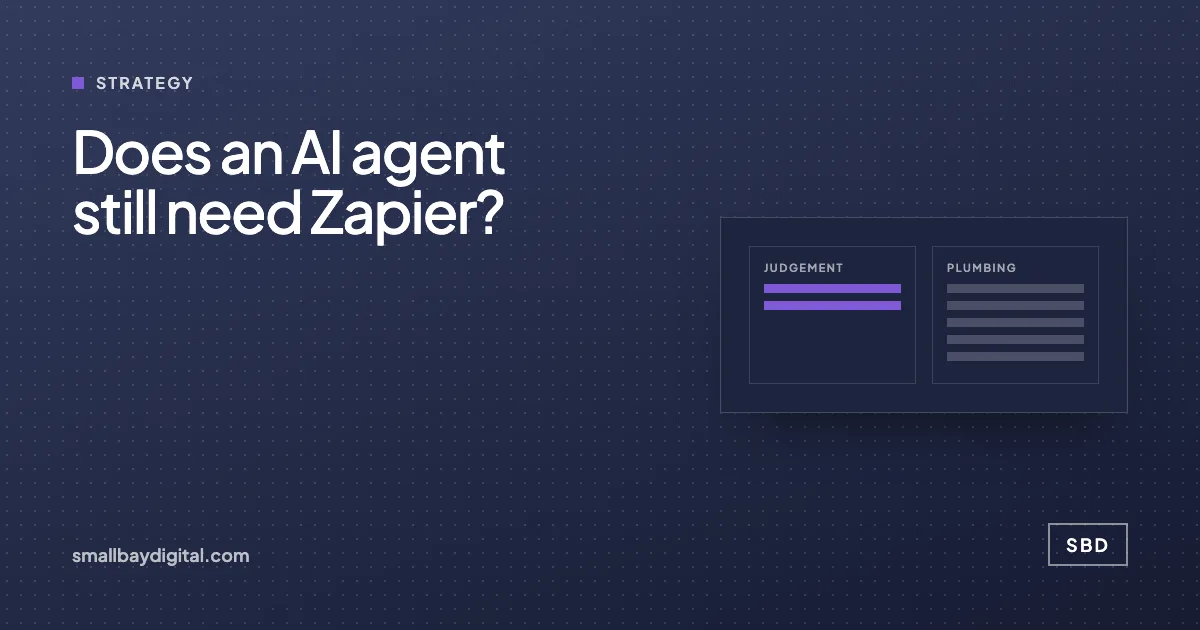
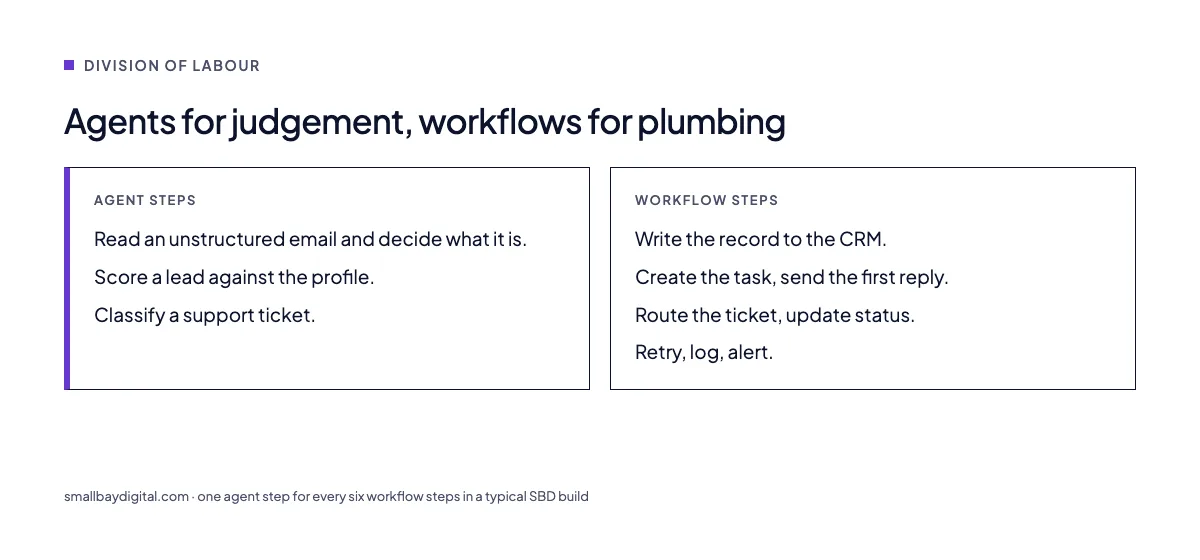
Agents are good at judgement and bad at plumbing. An agent that reads a screen and clicks is slow, expensive per run, and fails differently every time. A workflow that moves a record from one API to another is fast, costs a fraction of a cent, and fails the same way every time, which is what you want. Use agents for the steps that need judgement. Use workflow tools for everything that repeats. Zapier's own advice in October 2026 says the same.
Where the argument is right
An agent can do things no integration can. It can read an email with no structure, work out that it is an invoice, find the supplier in a messy table, and decide whether the total looks wrong. Five years ago that was a person. No Zap ever did it.
It is also right that the “connector” business is under pressure. If a model can read API documentation and call the endpoint, a pre-built connector is worth less than it was. Zapier knows this. Its MCP product lets any assistant call its 9,000 apps, and Next Gen Zaps lets you describe a workflow in Claude or ChatGPT and have Zapier build and run it. Zapier is turning itself into the plumbing for agents, and the post calls that silly.
Where it is wrong
Agents are expensive per step
An agent reading a screen and deciding where to click is a chain of model calls. Each costs money and takes seconds. A workflow step that maps a field costs nothing and takes milliseconds. For a process that runs eight hundred times a month, that difference is a bill and a wait.
Agents fail differently every time
The value of a deterministic workflow is that it does the same thing on run 1 and run 10,000. When it fails, it fails the same way, and you can fix it once. An agent fails creatively. That is fine for one task a person is watching. It is not fine for the invoice run at 2 am.
Someone still has to hold the credentials
“Agents speak API natively” skips the hard part: who holds the key, with what scope, and who sees the log. Integration platforms are, among other things, a credential store with an audit trail. Remove them and you build that yourself, or you hand an agent an admin token, which is how a database got dropped in nine seconds this year.
What we use for each job
| Job | Tool | Why |
|---|---|---|
| Read an unstructured email, decide what it is | Agent | Needs judgement |
| Move the result into the CRM | Workflow (n8n or Zapier) | Repeats, must be identical every time |
| Decide if a lead fits the profile | Agent, with a confidence score | Judgement, with a fallback to a person |
| Create the follow-up task and send the first reply | Workflow | Plumbing |
| Classify a support ticket | Agent | Judgement |
| Route it to the right queue and update status | Workflow | Plumbing |
| Match an invoice total to line items | Rule, not agent | Arithmetic needs no model |
In every system we have shipped this year, agents make up a small number of steps and workflows make up the rest. The agent steps are where the value is. The workflow steps are why it stays up.
What Zapier said on 13 October
Zapier’s own recommendation this month: start with AI to work out the job, move the steps that repeat into deterministic automation because it uses fewer tokens over time, and keep AI in the parts that need judgement. A company that believed agents replace workflows would not say that.
So will Zapier go to zero?
The connector catalogue is worth less than it was. The plumbing, the credential store, the audit log and the ten-thousand-run reliability are worth more, because there are now agents generating work that needs all four. Whether Zapier captures that value or n8n and code do is a business question. The engineering answer is settled: you need both layers.
The day an agent runs your invoicing from a screenshot and a prompt, faster and cheaper than a workflow, we will write the update. We are not holding our breath.
Questions we get asked
Can we skip the workflow tool and have the agent call APIs directly?
You can, in code, and for some builds we do. You then write the retries, the logging, the credential handling and the alerting yourself. That is what the workflow tool was giving you. It is worth it at scale, not for five workflows.
Should we use Zapier Agents or build our own?
For personal automation, Zapier Agents are quick. For a business process, we build the agent on n8n or in code so the permissions, the cap and the review queue are ours.
Does this change the Audit?
No. The Audit still starts from the work your team does by hand. Which steps get an agent and which get a workflow is a decision in the blueprint, not a starting assumption.
Sources and further reading
- Colin McGuire on X: Zapier is valued at $5B. It’s about to be $0.
- Zapier on X: start with AI, move repeated steps to deterministic automation, 13 October 2026
- Wade Foster on X: Next Gen Zaps, build a Zap from Claude or ChatGPT, 15 October 2026
- Zapier on X: give any AI agent access to 9,000 apps with Zapier MCP
- Lead enrichment and sales automation, an SBD build with one agent step and six workflow steps