



Manufacturing · Customer story
A part finder that decodes 6,000+ article numbers for a cable manufacturer.
An internal platform for a cable manufacturer that decodes positional article numbers across the catalogue, finds the right part in four steps, and turns enquiries into documents.
- Client
- SBEE Cables
- Industry
- Manufacturing
- What we built
- Part finder and product catalogue
- Built with
- Vercel
The results
- 6,000+article numbers decoded
Every finished-goods article mapped to its attributes.
- 39product categories
Grouped into about fifteen product families.
- 24lookup tables encoded
The catalogue's full numbering dictionary, now in software.
In short
SBEE Cables encodes every product attribute into positional article numbers across 39 categories, so finding the right part meant reading a 24-table catalogue. SBD decoded the scheme into a four-step part finder, a searchable product catalogue and master data, with an enquiry-to-documents flow following.
The product
Real screens from what we built.
-
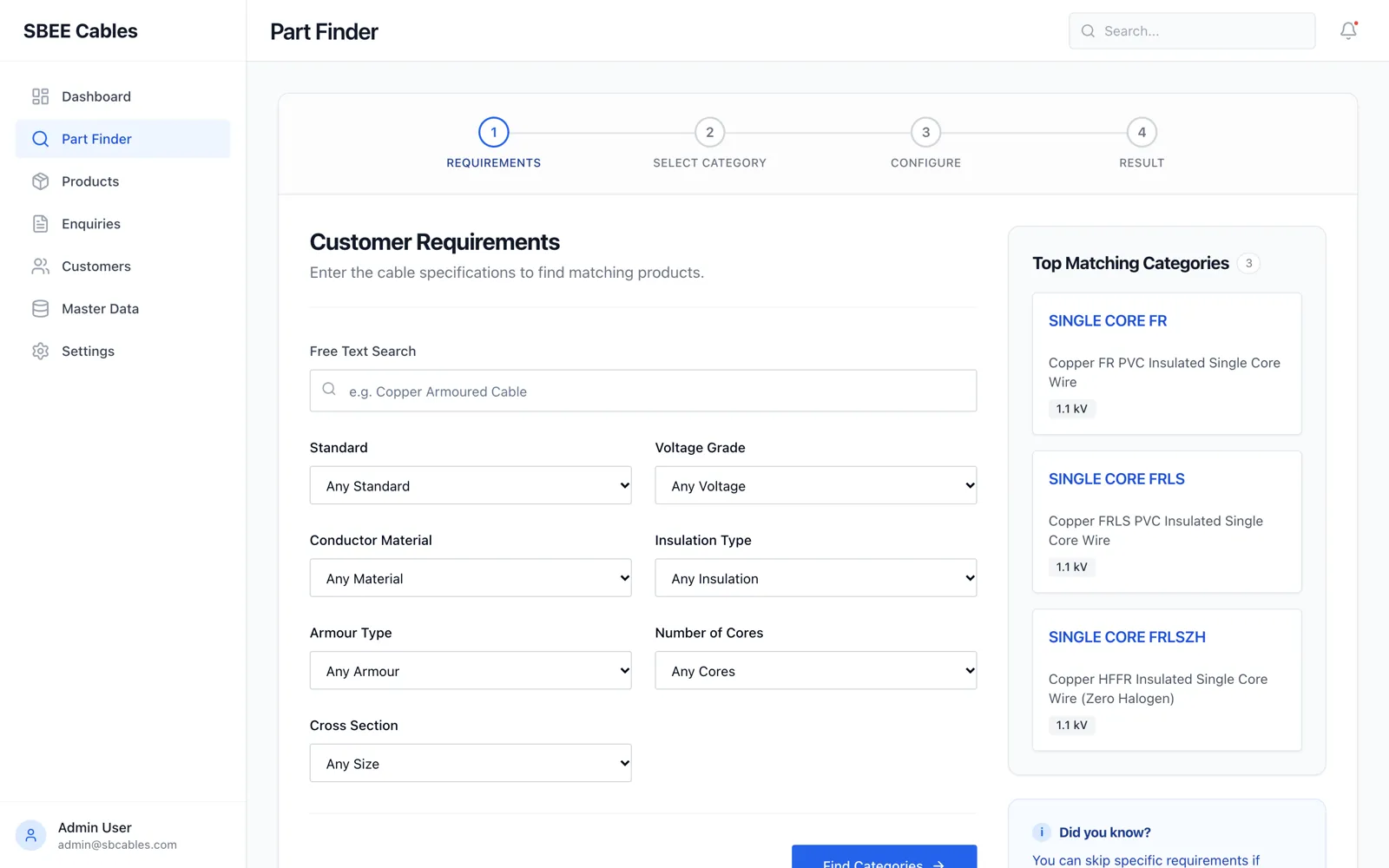
The four-step part finder, starting from customer requirements. -
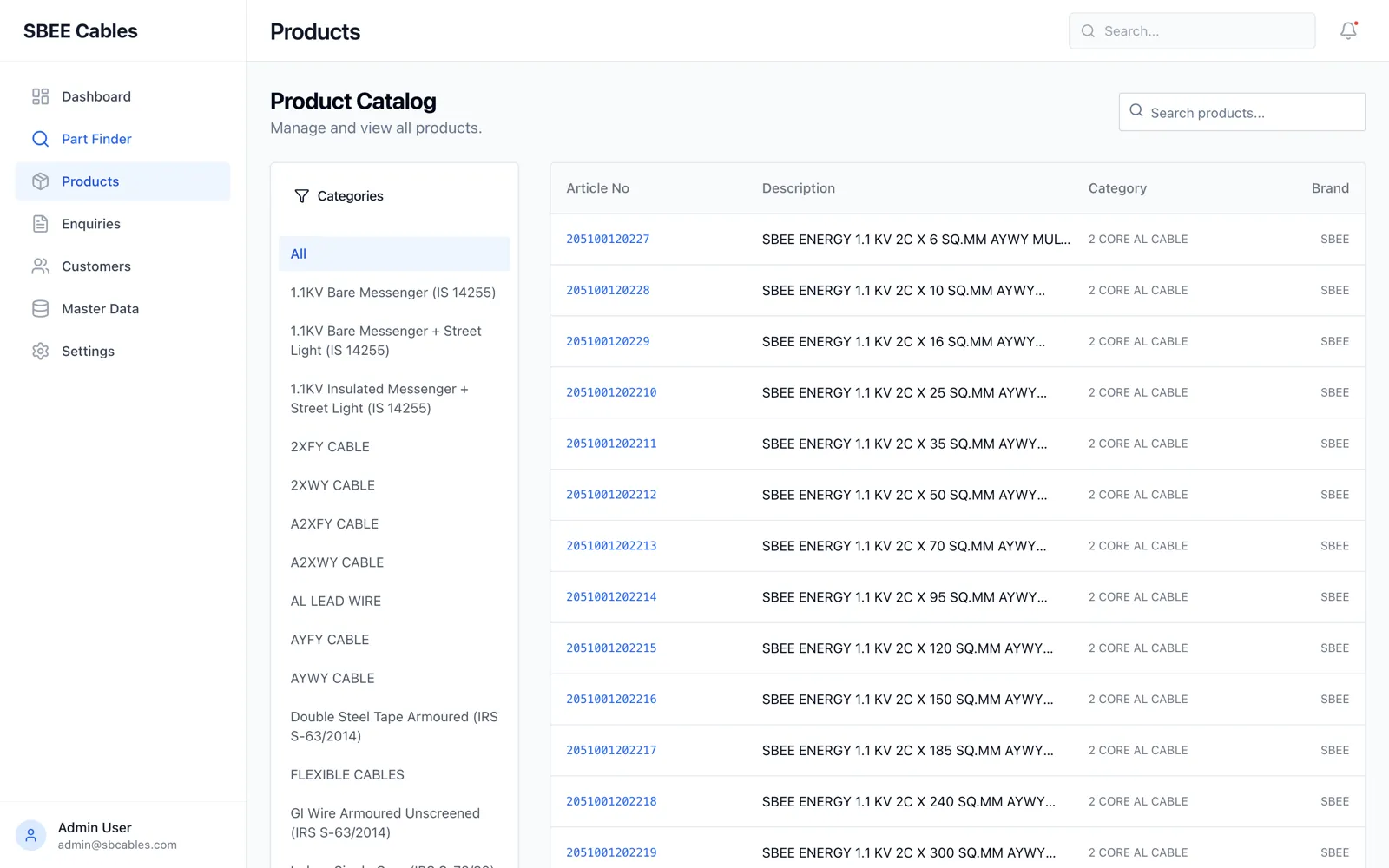
The product catalogue with decoded article numbers. -
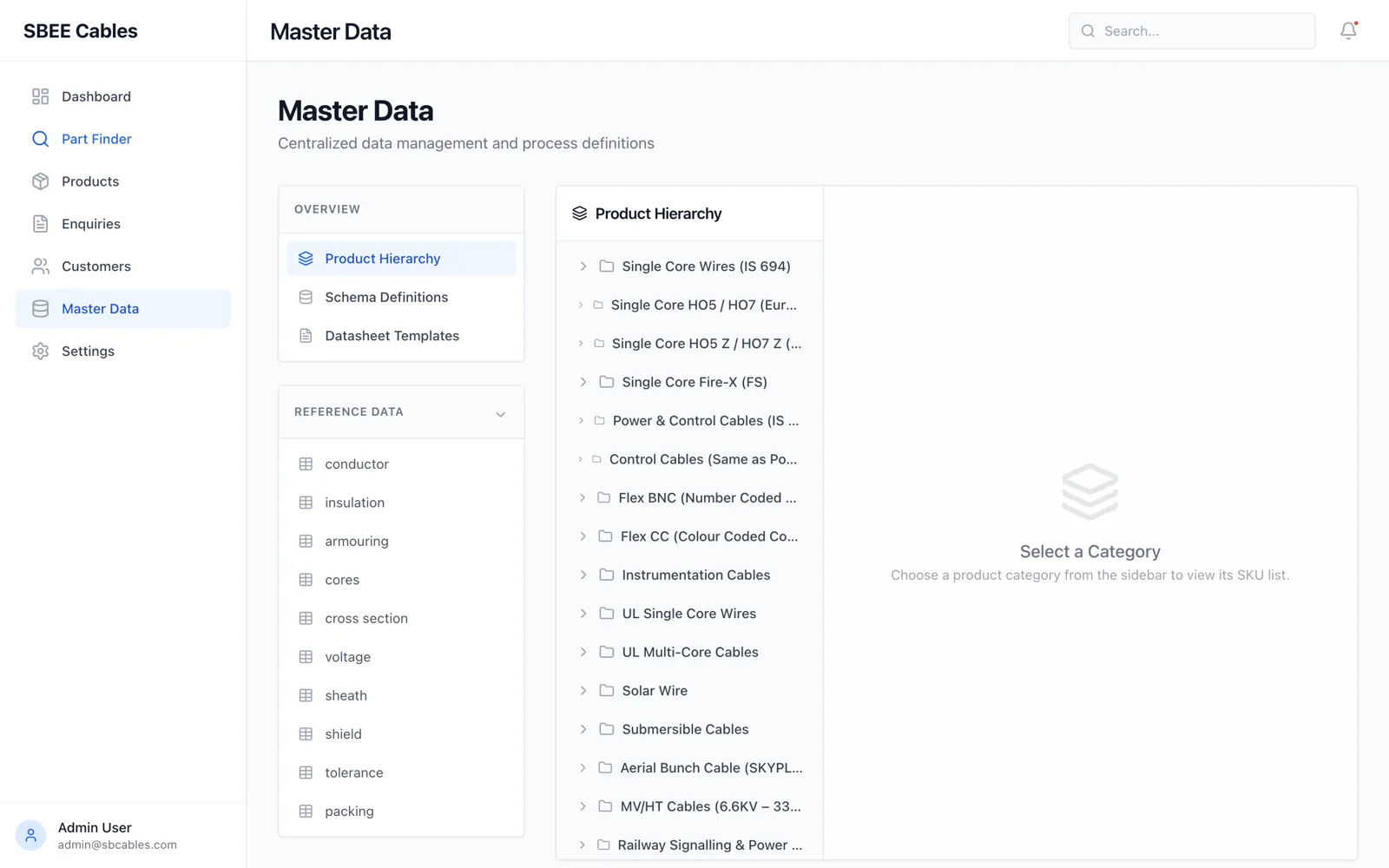
Master data: the product hierarchy and reference tables.
Before and after
What changed for the team.
| Before | After |
|---|---|
| Article numbers decoded by hand from catalogue tables | Article numbers decoded automatically from 24 lookup tables |
| Finding a part needed someone who knew the scheme | A four-step part finder anyone on the team can use |
| Some product families had no article numbers at all | Missing article numbers generated from the same rules |
| Enquiries turned into documents manually | Master data and product hierarchy in one place |
How we did it
How the part finder and product catalogue was built.
- 1Decode the catalogue
The full numbering scheme analysed: 39 categories, 24 master lookup tables, and the order each category combines them in.
- 2Clean the data
Over 6,000 article numbers checked against the scheme, with missing numbers for control cables generated by the same rules.
- 3Build the finder
A four-step wizard: requirements, category, configuration, result, with free-text search alongside.
- 4Ship and iterate
Version 1.0.2 live on Vercel, with enquiries and customer modules following.
The workflows
What runs now, and what sets it off.
- 01 Part finder
When a user enters requirements
ThenMatching categories and article numbers returned
- 02 Article decoding
When an article number is entered
ThenEvery attribute decoded from the lookup tables

What made it work
Treating the numbering scheme as the product. Once the 24 tables were encoded, search, validation and generation all came from the same rules.
What comes next
- Enquiries turned into documents from the catalogue
- Customer records linked to enquiries
For manufacturing teams
Production data in one place, this morning.
The same pattern, built around your tools. Bring the one workflow your team still runs by hand and we will show you what this would look like for you.
Show us your production sheet
Where this applies
The solutions this story proves.
- Industry
Manufacturing
Production entered once at the machine. Stock that matches the shelf. Dispatch paperwork and customer messages that send themselves. All of it live this morning, not typed up tonight.
- Function
Sales and RevOps
Reply to every lead in minutes, keep the CRM right without typing, and hand won deals over with nothing missing.
- Function
Operations
The order moves through the business without anyone re-typing it, and everyone who needs to know, knows.
How it starts
Every story on this page started with an audit.
One to two weeks. We map the work your team still does by hand, put an hours-a-week figure on each piece, and give you a costed blueprint in order of payback. The $500 is credited in full to the build.
- Week 1 to 2Audit with the people who do the work.
- Week 3Blueprint: fixed scope, fixed price, first build chosen by payback.
- Week 4 onTwo-week sprints, working software every second Friday.
- After go-liveSixty days of hypercare. Accounts and code in your name.
More customer stories