Accounting and finance
QuickBooks integration consultant: books that match the systems around them
SBD builds QuickBooks Online integrations for teams of 1 to 1,000 people: invoices, bills, payments and customers posted from the systems where the work happens, with every write checked and logged. Workflow automation builds start at $1,000, with the fixed price set after a $500 Automation Audit that is credited to the build.
- Tool
- quickbooks.com
- Usually paired with
- Shopify, HubSpot, Airtable, Gmail
- Timeline
- Most builds live in 2 to 8 weeks
- Owned by
- You, with accounts, credentials and code in your name.
What we build on QuickBooks
- Post sales, payouts, fees and refunds so the books match the bank
- Create invoices and bills from operations events
- Sync customers and items without duplicates
- Keep operations tools informed of paid status
What we sync
Workflows we are asked for
- Shopify payouts to QuickBooks
- Invoices from dispatch events
- QuickBooks paid status back to operations
- Expense and bill capture from email
Full write-ups of QuickBooks integrations

Tools QuickBooks usually needs to talk to
-
QuickBooks and Shopify
The storefront for most of the e-commerce businesses we work with.
-

QuickBooks and HubSpot
The CRM and marketing platform most B2B teams of 10 to 1,000 run on.
-

QuickBooks and Airtable
A relational database with a spreadsheet face, used as the operations base for teams who have outgrown sheets.
-
QuickBooks and Gmail
Google Workspace email, which is where most small-company processes still begin.
What a QuickBooks integration from SBD does
Most teams come to us when QuickBooks has become the place where errors surface.
Sales are keyed in twice, a payment processor posts summaries that nobody can tie back to orders, bills arrive as PDFs in a shared inbox, and the month-end close turns into a week of matching. Our job is to make QuickBooks the record of what happened, written to by the systems where it happened, so your bookkeeper reviews exceptions instead of retyping.
The work falls into four kinds. Sales posting: orders from Shopify, a CRM or a custom app become invoices or sales receipts with the right customer, items, tax codes and classes. Payables: bills read from documents, matched to vendors and accounts, and queued for a person to approve before they post. Payments and deposits: processor payouts broken into the charges, refunds and fees that make them up, so the bank feed matches. Reporting: figures pulled out of QuickBooks into a dashboard or a sheet that management reads every week.
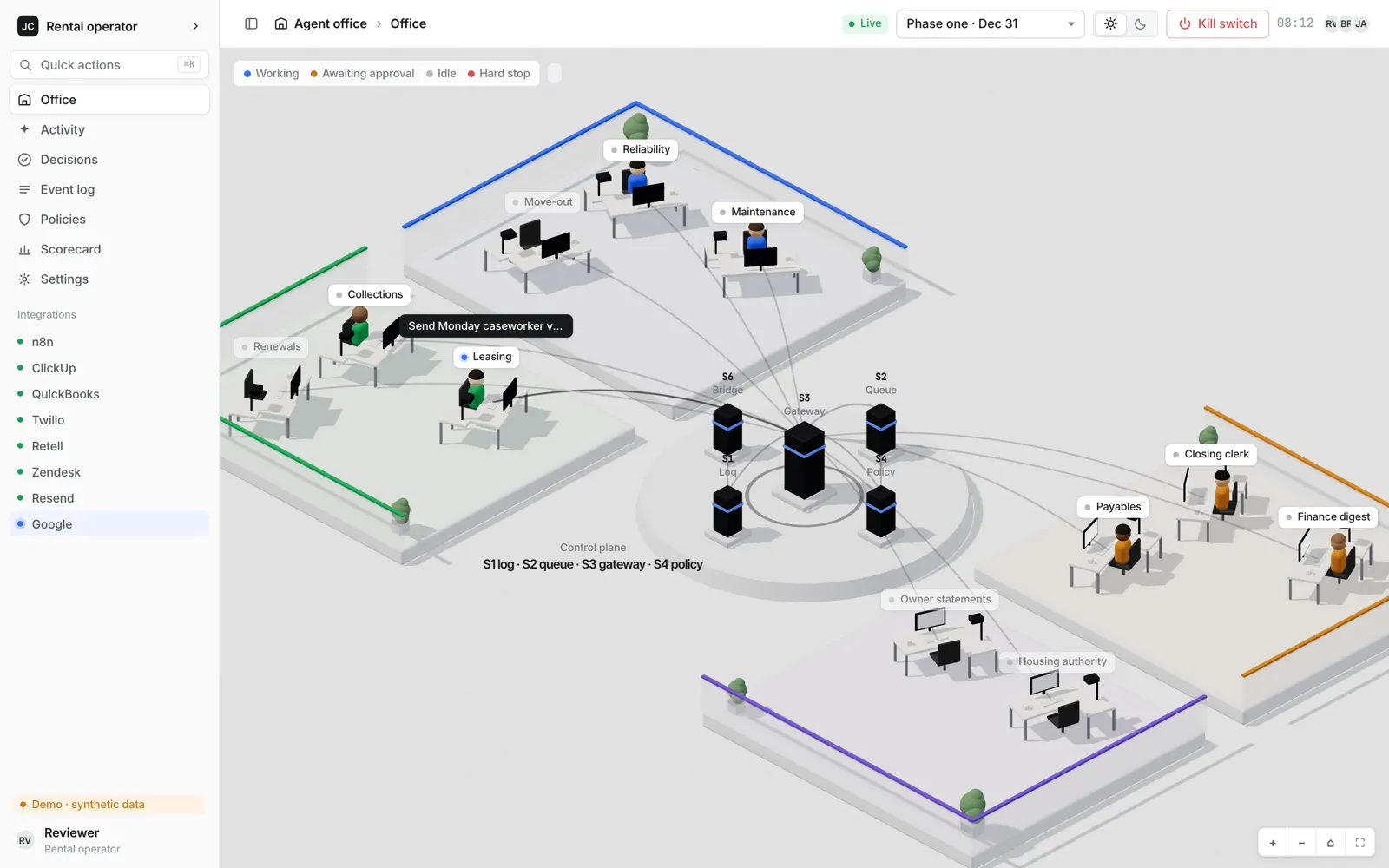
QuickBooks is in the stack of one published SBD project. For a US rental portfolio of around 120 properties we built six fixed-scope automations on n8n, including mortgage statements that are read, matched to the property and reconciled, and owner tax summaries generated from the records at year end.
When a custom integration beats a marketplace app
A good fit
The QuickBooks app marketplace covers the common pairs, and for many teams an off-the-shelf connector is the right answer. It is cheaper to buy than to build, and someone else maintains it. We will say so in the audit when it fits.
A custom integration earns its cost in a narrower set of cases
- Your chart of accounts, classes or locations need mapping rules that a connector cannot express, such as splitting one order across two revenue accounts.
- You need to post at the level of detail your accountant wants, rather than the daily summary journal many connectors default to.
- Several systems write to QuickBooks and one place must decide which wins when they disagree.
- You need an approval step, an audit log or an alert that a connector does not offer, for example a person signing off every bill above a set amount.
- The connector has failed silently before and nobody noticed until the close.
QuickBooks Online API limits, webhooks and tokens
QuickBooks Online throttles per company file, which Intuit calls a realm
From Intuit's limits page in October 2026: the REST API allows 500 requests per minute per realm ID and 10 requests per second per realm ID and app. The batch endpoint is throttled at 40 batch requests per minute per realm and app and 120 per minute per realm, with a recommended maximum of 30 payloads per batch. A throttled call returns HTTP 429, and Intuit's advice is to wait 60 seconds before retrying. Requests that run longer than 120 seconds time out, and a query returns at most 1,000 entities, so large reads must be paged. Intuit also notes that apps in the Builder tier of its App Partner Program include 500,000 CorePlus API calls per workspace a month, after which calls are throttled.
A webhook tells you that something changed, but it does not prove you have seen every change
Intuit requires your endpoint to answer with HTTP 200 within 3 seconds, retries failures at widening intervals from 10 seconds up to every 6 hours, and warns that you may not receive later events until the first one is acknowledged. Events can also arrive out of order, so the sync orders them by the timestamp in the payload. Intuit's own guidance is to back webhooks with Change Data Capture calls: CDC returns the full payload of entities changed in the last 30 days, up to 1,000 objects per response, and does not cover a handful of entities such as tax codes and tax rates. We build every QuickBooks sync with a queue behind the webhook and a scheduled CDC sweep, so a missed event is caught the same day.
Authentication is OAuth 2.0
An access token lasts one hour. A refresh token has a rolling expiry of 100 days inside a five-year hard lifespan, and each refresh can hand back a new refresh token that must replace the old one. The commonest cause of a QuickBooks sync that "stopped for no reason" is a refresh token that was not stored after a refresh, or a connection nobody used for 100 days. We store tokens in your own secrets store and alert a named person well before a connection lapses.
QuickBooks data model gotchas we design around
Every QuickBooks entity carries a SyncToken, a version number that increments each time the object is changed.
An update must send the current SyncToken, and Intuit's reference states that an attempt to modify an object with an older SyncToken fails. That is good for data integrity and bad for naive integrations: if a bookkeeper edits an invoice while your workflow is preparing its own update, the workflow's write is rejected. We read the object immediately before writing, compare what changed, and send conflicts to a person rather than overwriting their edit.
Other points that decide whether a QuickBooks integration is still trusted after six months:
- Customers and items are matched on a stable ID stored on both sides, never on a display name that someone will rename.
- Tax is calculated in one place. If your store calculates tax and QuickBooks recalculates it, the two drift by pennies and the reconciliation never closes.
- Each transaction has limits: Intuit caps most transactions at 10,000 line items, which matters for marketplace payouts posted as one document.
- Deletes and voids are handled explicitly. CDC reports a deleted entity with a status of Deleted, and the sync has to decide what that means downstream.
- Refunds and credit notes post as their own documents linked to the original sale, not as negative invoices.
How a QuickBooks engagement with SBD works
- Step 1$500Automation AuditCredited to the build
- Step 2from$1,000Workflow automationFixed after the audit
- Step 3from$3,000Internal toolsFixed after the audit
- Step 4from$50Care planA month, after sixty days of hypercare
Every engagement starts with an Automation Audit at $500, credited in full to your build. For QuickBooks we sit with whoever closes the books, trace one month of transactions from source to ledger, and list every place a figure is retyped, summarised or corrected. You get a ranked list of fixes, each with a fixed price, and a blueprint for the first build.
Workflow automation builds start at $1,000, internal tools at $3,000 and multi-module systems at $5,000, and the fixed price is set after the audit and agreed before work begins. We build on n8n, Make, Zapier or custom code depending on volume and how much logic sits in the mapping. Work runs in two-week sprints. Anything that moves money or contacts a customer for the first time waits for a person to approve it, and we typically run new syncs in shadow mode against a copy of the data before they write to your live file. After go-live there are sixty days of hypercare, and care plans start at $50 a month. See the pricing page.
Your QuickBooks subscription is paid by you to Intuit. We do not resell licences, and we work in your company file under a user you create and can remove.
What you own when the build is finished
Everything below is in your name when the build ends.
- The workflows, the OAuth app or connection, the logs and the secrets all sit in accounts you own.
- You receive a mapping document that lists every field and account each workflow writes to, a runbook for each sync that says what it does, what failure looks like and who is alerted, and a short guide for your bookkeeper on how to fix a rejected record and send it back through.
- If you later move to Xero or Zoho Books, the mapping document is the starting point for that migration, because the hard part of any migration is the decisions about accounts, tax and matching, and those are already written down.
- The audit will tell you whether a move is worth it before you spend on one.
QuickBooks at enterprise scale
Larger organisations typically run QuickBooks Online in finance teams that sit beside other systems: an ecommerce platform, a CRM, a property or practice management tool, or a group of entities that each keep their own company file. The integration problem grows with the number of company files and the number of systems writing to them, and it is usually owned by a finance lead or controller rather than IT.
Segregation of duties
Integrations post through a dedicated user with only the rights it needs. Bills, refunds and anything that moves money wait in an approval queue for a named person, and every approval is logged with who, when and what changed.
Multiple company files
Each realm has its own connection, token and limits. We keep one configuration per entity, so a mapping change in one company cannot leak into another, and alerts name the entity that failed.
Month-end confidence
A daily reconciliation compares source totals with what landed in QuickBooks and reports any gap before the close starts. The CDC sweep catches anything a webhook missed.
Audit trail
Every write records the source record, the payload sent, the QuickBooks ID returned and the SyncToken at the time. Your auditors can trace any figure back to where it came from.
Connection health
Refresh tokens expire after 100 days without use and can be revoked by any admin. We monitor each connection and alert a named owner before it lapses, with a written reconnect procedure.
Change control
Mapping changes are made in a test company first, reviewed with finance, and released with a note in the change log.
Engagements we take on
Already on QuickBooks, sales posted as summaries
A connector posts one journal a day per channel and nobody can tie it back to orders. We rebuild the posting at the level your accountant wants, with customers, items and tax lined up, and a daily check that totals match the source.
Already on QuickBooks, bills keyed by hand
Supplier invoices arrive by email and someone types them in. We read them, match the vendor and account, and queue each one for approval before it posts, so the team reviews instead of typing.
Already on QuickBooks, a sync that keeps stopping
An integration works for weeks, then quietly stops. We find the cause, usually token handling, stale SyncTokens or unhandled throttling, rebuild it with retries and monitoring, and hand over a runbook.
Several entities, one view
Each entity has its own company file and management wants one set of numbers. We pull the figures each week into a single reporting table with the mapping written down, so the consolidation stops living in one spreadsheet.
Read next
Sources
- Intuit Developer, API call limits and throttles for the QuickBooks Online REST and GraphQL APIs, checked 29 October 2026
- Intuit Developer, Webhooks best practices (3 second response, retry intervals, ordering, CDC backfill), checked 29 October 2026
- Intuit Developer, Change data capture operation (30 day look-back, 1,000 objects, excluded entities), checked 29 October 2026
- Intuit Developer, Set up OAuth 2.0 (access token lifetime, 100 day rolling refresh token, five-year lifespan), checked 29 October 2026
- Intuit Developer, Invoice entity reference (SyncToken behaviour on update), checked 29 October 2026
Standards on every build
Validation, retries, reconciliation, audit logs and alerts come as standard, with credentials and accounts in your name. Read the integration standards
What people ask about QuickBooks
Per-order invoices or summaries?
Summaries per payout or day past a few hundred orders a month. Line-level detail stays in the operational system where drill-down happens.
Start with the one QuickBooks workflow your team still runs by hand
Bring it to a discovery call. You leave with a yes or no on fit, an outline of the build and what we would do first.
Book the call