Databases and operations
Airtable consultant: bases designed, built and connected
SBD designs Airtable bases, builds the interfaces your team works from and connects them to the rest of your tools, for teams that have outgrown spreadsheets. Workflow automation builds start at $1,000 and internal tools at $3,000, with the fixed price set after a $500 Automation Audit that is credited to the build.
- Tool
- airtable.com
- Usually paired with
- Shopify, HubSpot, Tally, Zoho Books
- Timeline
- Most builds live in 2 to 8 weeks
- Owned by
- You, with accounts, credentials and code in your name.
What we build on Airtable
- Design the base as a schema with linked tables and keys
- Sync orders, deals and invoices in from your other tools
- Build approval and review queues the team works from
- Move heavy tables to Postgres when the base slows down
What we sync
Workflows we are asked for
- Airtable order management for Shopify
- Airtable as a CRM synced with HubSpot or Pipedrive
- Airtable approval workflow with notifications
- Airtable to accounting sync
- Airtable inventory with reorder alerts
Full write-ups of Airtable integrations
-
Shopify and Airtable
An Airtable base that stays in step with Shopify through refunds, partial fulfilment and edits.
-

HubSpot and Airtable
Sales stays in HubSpot, delivery runs in Airtable, and neither team re-types the other’s data.
-

Tally and Airtable
Tally stays the book of record, and your team can see what is in it without asking accounts.
-

Zoho Books and Airtable
Invoice from the event that earned it, and see what is outstanding without opening Books.
-

WhatsApp and Airtable
Reach customers where they reply, with the conversation logged against the record.
-

Airtable and Retool
Airtable is a good database with a limited interface. Retool adds the screens and permissions it lacks.
-

Pipedrive and Airtable
Close the deal in Pipedrive, run the work in Airtable, and keep both honest.
Tools Airtable usually needs to talk to
-
Airtable and Shopify
The storefront for most of the e-commerce businesses we work with.
-
Airtable and HubSpot
The CRM and marketing platform most B2B teams of 10 to 1,000 run on.
-
Airtable and Tally
TallyPrime, an accounting and inventory system used widely across South Asia, the Middle East and Africa.
-
Airtable and Zoho Books
Zoho's accounting, with VAT, GST and sales tax support across regions and tight links to the rest of Zoho.
-
Airtable and WhatsApp Business API
The channel customers in most markets reply on, with templates, sessions and consent rules.
-
Airtable and Retool
Internal tools built fast on top of your database and APIs, with roles.
-
Airtable and Pipedrive
A sales-first CRM for small teams, with a straightforward API.
-

Airtable and SmartSuite
A work management database in the Airtable family, with stronger permissions and views.
What an Airtable developer from SBD builds
Airtable is one of several places we put operational data.
We choose it when a team needs a shared, structured record of orders, jobs, deals or assets that non-technical people can read and edit, and the volume fits comfortably inside a base. Where it does not fit, we say so and use Postgres, SmartSuite or a custom app instead.
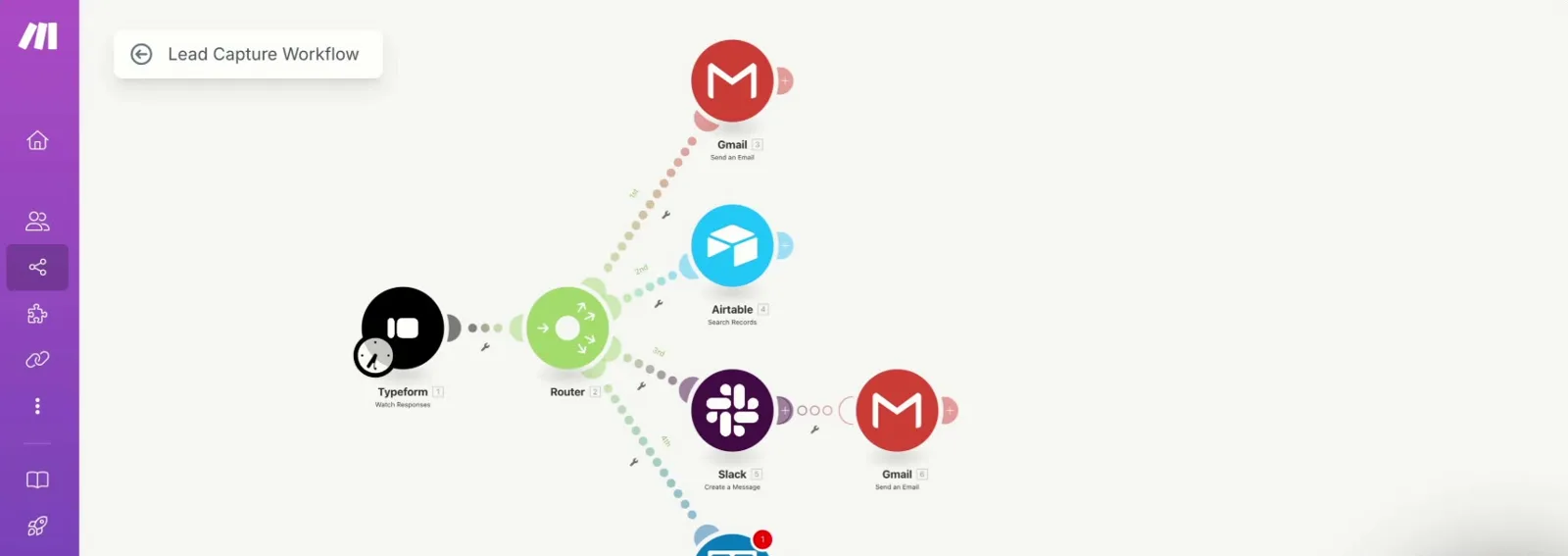
The work itself is mostly schema and plumbing. We design tables, linked records and keys so the base behaves like a database rather than a large spreadsheet. We build interfaces so each role sees the records and buttons it needs and nothing else. And we connect the base to everything around it with n8n or Make, handling the API limits properly so syncs do not fail quietly.
We have not yet published a case study built on Airtable, so we will not point you to one. The closest published work is a product sync on SmartSuite and Make, which follows the same pattern: one structured base holding each record once, with automations pushing changes out to other systems.
When Airtable is the right choice, and when it is not
A good fit
Airtable is a good fit for operations teams with thousands to tens of thousands of records, several linked object types, and people who need to work in views and forms without training. Its interfaces let you build a focused front end for each role on top of the same data, so a field team can see today's jobs on a phone while managers review the same records in a dashboard. Built-in automations handle simple notifications well; anything that crosses several systems or needs retries we move into n8n or Make.
We will steer you elsewhere when
- Record counts will pass the plan limit within a year or two; a database such as Postgres scales further.
- Many systems need to write to it at high frequency; the API rate limit becomes the bottleneck.
- You need strict, row-level permissions for external users; a purpose-built app handles that better.
- Your team only needs a list; a shared sheet costs less and is easier to live with.
Airtable record, automation and API limits by plan
Airtable's limits are generous for a single team and tight for a busy integration. The record cap is per base, so splitting data across bases buys room but makes reporting and linking harder. The rate limit is per base too, which means a nightly sync of 10,000 records has to be batched and paced, and any integration we build retries on a 429 rather than dropping the write. We size these against your numbers in the audit.
From Airtable's plan documentation in October 2026, per base and per workspace:
- Records per baseFree 1,000; Team 50,000; Business 125,000. Enterprise Scale limits are set with Airtable's sales team.
- Attachment storage per baseFree 1 GB; Team 20 GB; Business 100 GB.
- Automation runs per workspace per monthFree 100; Team 25,000; Business 100,000.
- API calls on Free1,000 per workspace per month.
- API rate limit5 requests per second per base. Exceed it and the API returns a 429 and you wait 30 seconds. Personal access tokens from one user also share a 50 requests per second limit.
How hiring an Airtable agency like SBD works, and what it costs
- Step 1$500Automation AuditCredited to the build
- Step 2from$1,000Workflow automationFixed after the audit
- Step 3from$3,000Internal toolsFixed after the audit
- Step 4from$50Care planA month, after sixty days of hypercare
Every engagement starts with an Automation Audit at $500, credited in full to your build. For Airtable that includes mapping the records you hold today, how fast they grow, and who reads and writes them, so we can tell you whether Airtable will still fit in two years.
Workflow automation builds start at $1,000, internal tools at $3,000 and multi-module systems at $5,000, and the fixed price is set after the audit and agreed before work begins. A typical Airtable build covers the schema, interfaces for each role, data migration from your current sheets or tools, and the integrations that keep it in sync. Work runs in two-week sprints and includes sixty days of hypercare. Care plans then start at $50 a month for monitoring, support with a stated response time and small monthly changes. Nothing is billed by the hour; see the pricing page.
Your Airtable subscription is paid by you to Airtable. We recommend the plan during the audit based on your record counts and automation runs.
What you own, and moving into or out of Airtable
Everything below is in your name when the build ends.
- The base, the workspace and every integration account are in your name.
- You receive a schema document listing each table, field and link, a guide to each interface, and a runbook for every sync that says what it does and how it alerts when it fails.
- Most of our Airtable work starts with a migration in: spreadsheets, a legacy CRM or a tangle of forms consolidated into one base, with duplicates cleaned and links rebuilt.
- Some starts with a migration out, when a base has hit its record limit or rate limit and the heavy tables need to move to Postgres while the team keeps the Airtable views they know.
- Either way we plan the cut-over so nobody loses a day's work, with a dry run on a copy of the data and a short freeze on edits while the final load runs.
Airtable at enterprise scale
Airtable is common in larger organisations as a shared operational database for marketing operations, content and production planning, product teams, programme management and research groups. It often spreads team by team, so a company can end up with many workspaces and hundreds of bases. Airtable's pricing describes Enterprise Scale as allowing unlimited org units, workspaces and bases, and mentions HyperDB for very large data sets. Its Business plan includes an admin panel and up to 125,000 records per base.
Base sprawl and a shared data model
We audit every workspace and base, find duplicated tables such as several separate client or product lists, and agree which base holds the master copy of each. Shared records move to a core base and reach team bases through Airtable sync, so teams keep their own views without copying data by hand.
Admin, SSO and permissions
We use the admin features on your plan to review who owns which workspaces, remove stale collaborators and set sharing rules. Where your plan includes SSO we connect it to your identity provider. Interfaces give teams the views and edit rights they need without opening the raw tables.
Scale limits and when to move to Postgres
Business bases hold up to 125,000 records, and the API has rate limits. When a base nears those limits or needs heavy reporting, we move the large tables to Postgres or your warehouse and keep Airtable as the working layer for people, with sync in both directions only where a team needs it.
Change control for automations and schema
We document fields, automations and scripts per base, test schema changes in a copy before applying them, and keep a change log. Automations that call outside systems are moved to n8n or Make when they need retries, logging or approval steps that Airtable automations do not offer.
Security reviews and data handling
We list what personal or sensitive data sits in each base, remove what should not be there, and restrict shared views and forms. For security questionnaires and DPAs on the work SBD does, see our trust centre and security page.
Governance and training
We write naming and documentation rules, a template for new bases, and an intake process for requests. Base owners in each department are trained on the standards and on when to ask for help, so the estate stays tidy after the clean-up.
Engagements we take on
Already on Airtable across five departments, bases have sprawled
Each team built its own bases and the same clients, projects or products now live in several places. We map the estate, design a core base with the shared records, sync it to team bases, retire duplicates and document what remains. Teams keep their familiar views; reporting starts from one set of data.
Your largest base is hitting record and API limits
A key base is slow, near its record limit, or failing integrations because of rate limits. We move the heavy tables to Postgres, keep Airtable for the people who edit records day to day, and rebuild the integrations with batching and retries. You keep the interface your teams know.
Add approvals and AI steps to Airtable workflows
Requests, content or vendor records move through Airtable and you want a model to summarise, tag or draft. We add the AI step through n8n or Make, write results back to the record, and route anything uncertain to a person for approval in an Airtable interface.
Prepare an Airtable estate for a security review
Your security team wants to know what data sits in Airtable and who can see it. We inventory bases, shared views, forms and API tokens, remove public links that should not exist, tighten permissions and produce a register with owners and data categories for the review.
Read next
Standards on every build
Validation, retries, reconciliation, audit logs and alerts come as standard, with credentials and accounts in your name. Read the integration standards
What people ask about Airtable
When is Airtable the wrong choice?
When a table will grow past the plan's record cap or when many people write at once. Then the record of truth belongs in Postgres or Supabase, with Airtable kept for the records people edit by hand.
Can you take over an existing base?
Yes. We start with a schema review, fix the keys and links, and only then wire the integrations, so the sync is not built on a base that will need to change.
Start with the one Airtable workflow your team still runs by hand
Bring it to a discovery call. You leave with a yes or no on fit, an outline of the build and what we would do first.
Book the call