





Every n8n hiring post on the community forum this month asks for the same thing: someone to build, and someone to keep it running. The second half is the self-hosting question in disguise.
n8n is open source. You can run it on a five-dollar server. The pricing page says a cloud Starter plan is €20 a month. So why would anyone pay?
The short answer
Below about 10,000 workflow runs a month, use n8n cloud. The server is cheap but the upgrades, backups, queue mode, SSL and the 2 am restart are not, and for a small team they land on whoever knows the most about computers. Above that, or if you have a real reason to keep data on your own infrastructure, self-host, and budget a few hours a month of someone's time for it. We run both for clients and put most teams of 1 to 50 on cloud.
What the numbers say
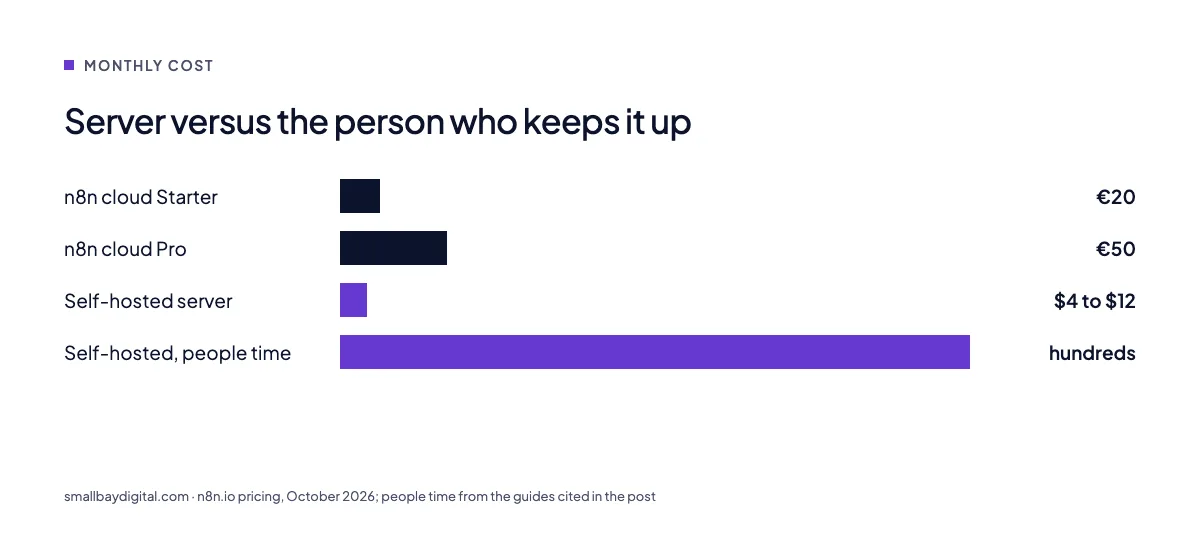
From n8n’s pricing page in October 2026: Starter at €20 a month for 2,500 executions, Pro at €50 for 10,000, Business at €667 for 40,000. An execution is one full run of a workflow, however many steps.
Self-hosted, the software is free. Estimates for the server across the guides we checked run from about $4 to $12 a month for a small instance, and more once you add a managed Postgres, a queue worker and backups.
Those two numbers are what the “self-host and save” posts compare. They are comparing the wrong things.
What you take on when you host
- Upgrades. n8n ships often. Some releases change behaviour. Someone reads the notes and upgrades, or you fall behind and lose nodes that need the new version.
- Backups. Your workflows and credentials live in that database. If it is not backed up and tested, one bad upgrade is the end of the automation.
- Queue mode. A single instance handles a few concurrent runs. Past that you need workers and Redis, which is a different setup.
- Secrets. Credentials are encrypted with a key you hold. Lose the key, lose every connection.
- The 2 am restart. Memory leaks, disk full, a webhook that stops registering. Someone is on call, and in a small team that is the founder.
One guide we read put the fully loaded cost of self-hosting for a small team at several hundred dollars a month once people time is counted. The exact number depends on who the person is, but the shape is right: the server is the smallest line.
The break-even
Roughly, cloud Pro at €50 covers 10,000 runs. A self-hosted setup with a managed database and a few hours of attention a month costs more than that in time alone until you are well past 10,000 runs, or until the time is free because you already run servers.
So the rule we use:
| Situation | Our answer |
|---|---|
| Under 10,000 runs a month, no ops person | Cloud |
| Over 10,000 runs, someone already runs infrastructure | Self-host, queue mode from day one |
| Data residency or contractual reason to stay on your servers | Self-host, with a managed Postgres and tested backups |
| Agency running many clients | Self-host one instance per client, or cloud per client, never shared |
What we do
For most clients of 1 to 50 people we start on cloud Starter or Pro in an account in the client’s name. If the run count climbs past the Pro tier, we move them to a self-hosted instance we set up with queue mode, managed Postgres, backups and monitoring, and the care plan covers the upkeep. Either way the account and the data are theirs, which is written into every statement of work.
Questions we get asked
Is cloud n8n less private than self-hosting?
Your data passes through n8n’s servers during a run on cloud. For most small businesses that is fine and no different from using Zapier. If you handle data under a contract that says otherwise, self-host.
Can we start on cloud and move later?
Yes. Workflows export and import as JSON. Credentials have to be re-entered. We have moved clients both directions in an afternoon.
What about the free community edition on a laptop?
Fine for learning. Not for a workflow the business depends on. Laptops sleep.
Sources and further reading
- n8n pricing, read 20 October 2026
- n8n pricing 2026: cloud, self-hosted and real costs, Lowcode Agency
- n8n self-host vs cloud in 2026: the RevOps decision guide
- n8n cloud vs self-hosted on AWS: the real cost in 2026, AppXen
- n8n community: top topics this month, where most posts are hiring for build and upkeep
- The Zapier tax in 2026, the same question for Zapier