







“We tried AI and nothing stuck.”
It is the most common opening line on our first calls, and it is usually said with some embarrassment, as though the company failed a test. They bought seats. They ran a lunch-and-learn. Someone built a chatbot. Three months later the seats were unused and the chatbot answered questions nobody asked.
Nothing was wrong with them. Something was wrong with the attempt.
The short answer
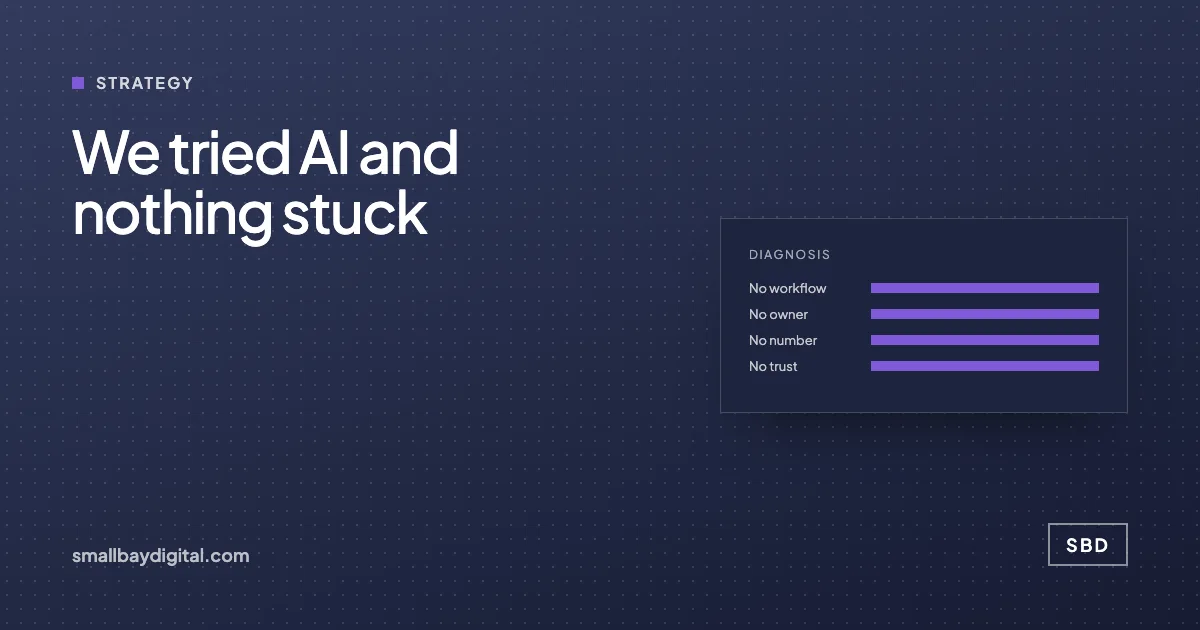
AI tools get abandoned in small companies for four reasons: there was no specific workflow, so nobody knew when to use the tool; there was no owner, so nobody fixed it when it misbehaved; there was no number, so nobody could see it working; or the first results were wrong in a visible way, so the team stopped trusting it. The fix for all four is the same. Pick one workflow the team still runs by hand, give it an owner, put a number on it, and keep a person in the loop until the number moves.
The four reasons
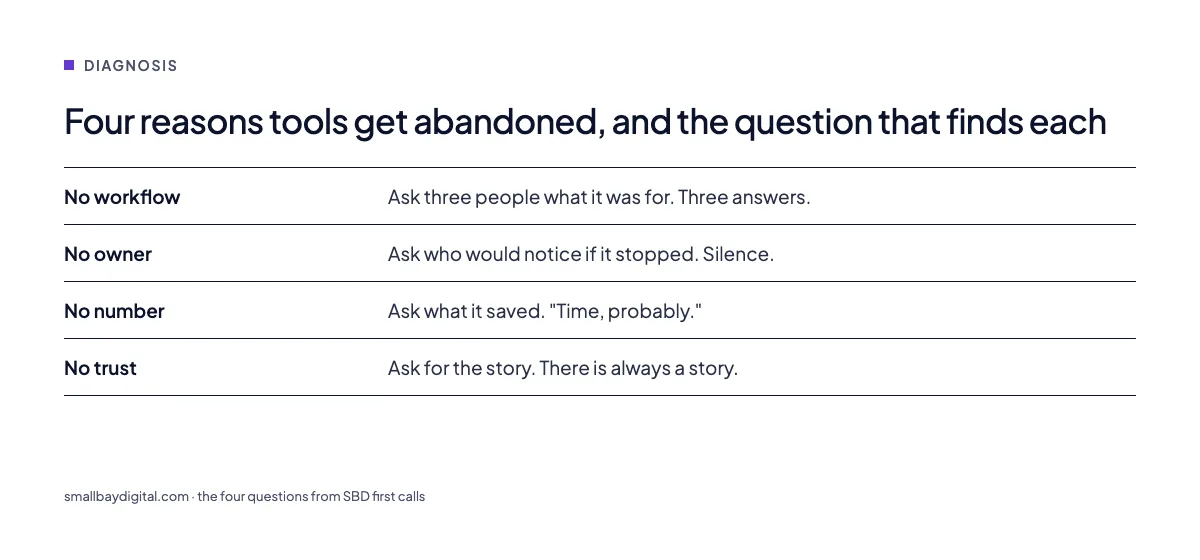
1. No workflow
“Use AI” is not a task. A tool with no specific job gets opened twice and forgotten. The successful cases in MIT’s study of AI pilots were narrow: one workflow, one output. The ones that showed no effect were general tools given to everyone.
How to tell. Ask three people what the tool was for. If you get three answers, this is the reason.
2. No owner
The tool was set up by whoever was most enthusiastic, often the owner or a junior person who has since moved on. When it gave a wrong answer or stopped connecting, nobody’s job was to fix it, so it stayed broken.
How to tell. Ask who would notice if it stopped tomorrow. Silence is the answer.
3. No number
Nobody wrote down what the tool was supposed to change, so nobody could see it changing anything. The seats looked like a cost with no return, and they were cut.
How to tell. Ask what it saved. If the answer is “time, probably”, this is the reason.
4. No trust
The first week it did something visibly wrong: a confident wrong answer to a customer, an invoice total off by a decimal place. The team saw it, and from then on checked everything it did, which was slower than not using it.
How to tell. Ask for the story. There is always a story.
Why the retry works
A second attempt that fixes those four things looks different from the first.
- It starts from a workflow the team runs by hand every day, which means they know exactly what good looks like.
- It has a person in the team who owns it, not the IT person, not the agency.
- It has a number: leads replied to in under an hour, invoices posted without typing, tickets routed without a human.
- It runs in shadow mode first, deciding while a person acts, so the first thing the team sees is it being right.
The last point is the one most companies skip and the one that matters most. Trust comes from watching it be right before it is allowed to act.
Before and after
| First attempt | Second attempt | |
|---|---|---|
| Scope | A tool for everyone | One workflow |
| Owner | Whoever set it up | A named person in the team |
| Measure | None | One number, checked weekly |
| First week | Live, and wrong once | Shadow mode, right in front of everyone |
| Outcome | Seats cancelled | Second workflow requested |
What to do this week
- Write the sentence: “We still do X by hand, and it takes Y hours a week.” If you cannot, you are not ready for a tool. You are ready for an audit.
- Name the owner. Not you, unless you do the work.
- Pick the number.
- Do not switch anything on until it has been right in shadow mode for a week.
Questions we get asked
We have no technical person. Can it still stick?
Yes. The owner needs to know the workflow, not the tool. The technical part is ours during the build and the care plan after.
Should we try again with the same tool?
Maybe. The tool was rarely the problem. If it was a general chat tool, no, because a general tool cannot be given one workflow. If it was an automation platform, probably yes.
How long before we know?
A workflow that has been right in shadow mode for a week and live for a month, with the number moving, has stuck. If the number has not moved in a month, stop and look upstream.
Sources and further reading
- MIT finds GenAI projects fail ROI in 95% of companies, National CIO Review
- The 95% figure, read properly, our reading of that study
- The 2026 AI readiness checklist, the ten questions before any build
- Small businesses keep abandoning AI tools, The Useful Daily, on narrow tools sticking
- Multi-user production dashboard, a second attempt that stuck