







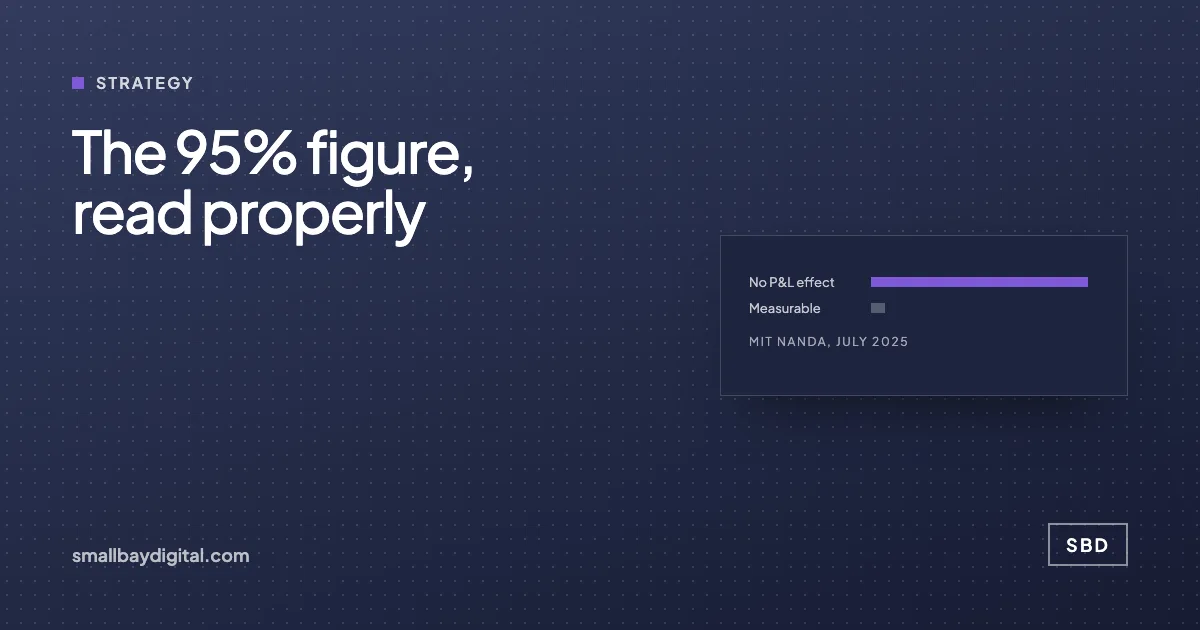
We quote it on our own homepage: about 95% of AI pilots never reach the profit line. Clients quote it back to us. Consultants put it on slide two. It comes from one report, published by MIT’s NANDA project in July 2025, titled The GenAI Divide.
Because we use the number, we owe you what is behind it.
The short answer
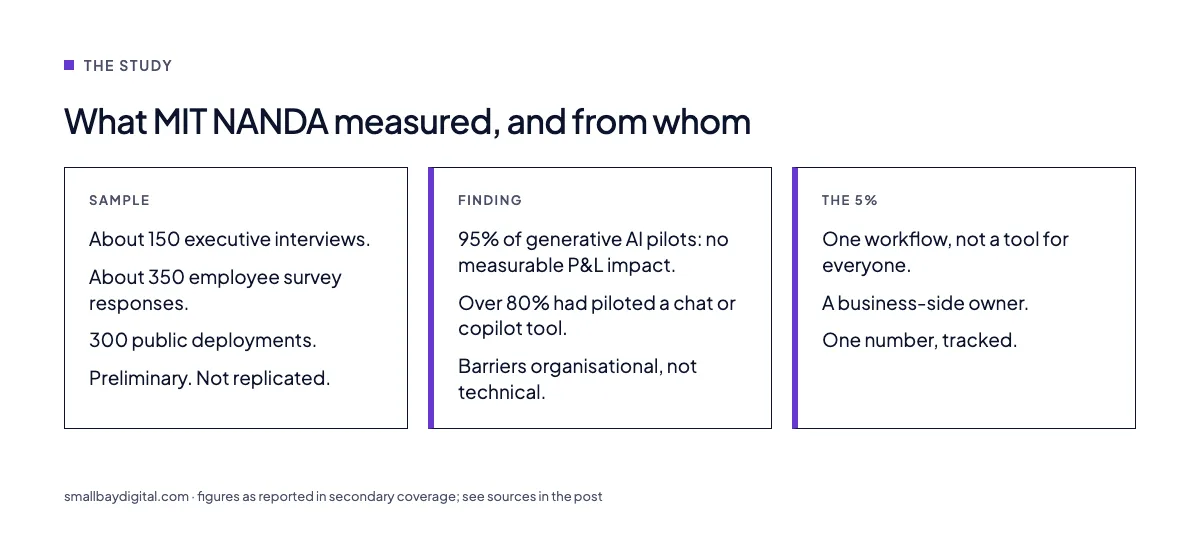
The 95% figure comes from a preliminary MIT study of roughly 150 executive interviews, 350 employee survey responses and 300 public deployments, depending on which write-up you read. It found that most organisations piloting generative AI saw no measurable profit-and-loss impact, while a small group did. The sample is small and self-reported, so treat 95% as a direction, not a measurement. The finding that holds up is why the 5% succeeded: they bought or built narrow tools for one workflow, with a named owner, and measured one number.
What the study was
MIT’s Project NANDA published The GenAI Divide: State of AI in Business 2025 in July 2025. Coverage at the time described it as preliminary. The reported method varies by source: one says 52 executive interviews, 153 survey responses and 300 public deployments; another says about 150 interviews and 350 survey responses. Either way, it is a small, self-reported sample of mostly large organisations.
Its headline: despite $30 to 40 billion in enterprise investment, 95% of generative AI projects showed zero measurable P&L impact.
What it measured
It measured whether leaders could point to a profit-and-loss effect from a generative AI pilot. It did not measure whether staff found tools useful, and in fact it found the opposite problem: over 80% of organisations had piloted something like ChatGPT or Copilot, and those tools improved individual productivity without showing up in the accounts.
So the divide is not between companies that use AI and companies that do not. It is between companies where AI is a personal tool and companies where it is part of a process that moves a number.
What it did not measure
- Small businesses. The sample skews to enterprises with budgets large enough to run pilots. A 20-person company automating invoice intake is not in the data.
- Automation. The study is about generative AI pilots, chat and copilot style. Workflow automation with an AI step inside it is a different category and was not the subject.
- Time. A pilot that showed nothing in six months may show something in eighteen. The study is a snapshot.
No formal follow-up from MIT has re-measured the rate as of October 2026. The number is repeated constantly and has not been replicated.
What the 5% did
This is the part worth keeping. The report describes the organisations that saw impact as doing a few things differently:
- They bought from vendors or built narrow tools for a specific workflow, rather than general-purpose chat for everyone.
- They gave the tool a process owner on the business side, not in IT.
- They picked one measurable outcome and tracked it.
- They treated the barriers as organisational, not technical. The report says this directly.
None of that is about the model. All of it is about the work around the model.
Why we quote it anyway
Because the direction matches what we see in audits. Companies arrive having bought seats of something, with no process changed and no number moved. The pilots that worked were the ones that started from a workflow the team still ran by hand.
We just make sure to say “about 95%” and to link the source, which is what this post is for.
What to do with it
- If you have an AI pilot running, name the number it is meant to move. If nobody can, that is the finding.
- Give it an owner in the team that does the work.
- Narrow it. One workflow, one output, one month.
- Then widen.
That is also the shape of our Audit: one to two weeks, the workflows your team still runs by hand, a number on each, and a blueprint in order of payback.
Questions we get asked
Is the 95% number wrong?
It is unverified rather than wrong. It comes from a small sample and has not been replicated. The direction, that most pilots show no profit effect, is consistent with other reports, including Gartner’s estimate that a large share of agent projects will be cancelled by 2027 for unclear value.
Does it apply to a small company?
The sample does not, the lesson does. Small companies have an advantage: one workflow is a large share of the business, so one working automation shows up in the accounts quickly.
What is the 5% doing differently in one sentence?
Starting from the work, not from the tool.
Sources and further reading
- MIT: 95% of enterprise AI pilots fail to deliver measurable ROI, Healthcare IT News, on the NANDA report
- MIT report finds most AI business investments fail, reveals GenAI divide, Virtualization Review
- MIT finds GenAI projects fail ROI in 95% of companies, National CIO Review
- 2026 is AI’s “show me the money” year, Axios
- The 2026 AI readiness checklist, the ten questions we ask before any build