By role: Founders and CEOs
AI and automation for founders who are still the system
If each answer runs through you, the business can only grow as far as your hours allow. We move routine work into systems your team owns, so your week goes on the decisions only you can make.
- First workflow live
- Founder morning brief, usually inside the first sprint
- Usually owned by
- Founders and CEOs of growing businesses
- Built on
- n8n, Make, Airtable
- Judged on
- Questions routed to you and Founder hours on admin
For a founder, AI automation means moving the routine decisions and follow-ups that run through you into systems the team can run: one record per customer and order, status updates sent when work moves, and a daily summary in place of a stream of questions. SBD starts with a $500 audit, credited to a fixed-price build from $1,000.
Where the hours go
Usually brought in by Founders and CEOs of growing businesses, Owner-managers of family businesses or Second-generation owners modernising how things run.
Tick what is true for your team
Most teams that bring us in tick two or more.
- 01
You are the integration layer
Sales, operations and finance each ask you, because you are the only one who knows how the pieces fit.
- 02
You tried AI and it did not stick
You paid for a few subscriptions and a chatbot, and saw a good demo. None of it changed how the work gets done on a Tuesday.
- 03
Hiring is the only lever you have used
Each new hire adds capacity and another person copying data between tools, so headcount grows faster than revenue.
- 04
You find out about problems late
A missed follow-up or a late order reaches you when the customer complains, often days after it happened.
What we build for founders and CEOs
Pick one to see what it does and the event that sets it off.
Your processes written into a system
Your processes mapped and built into one system of record, so the team can answer questions without asking you.
Follow-ups triggered by events
Leads answered, quotes chased and customers updated from events in the system, with exceptions routed to a person.
A morning brief
One summary each day of what is late, what is at risk and what needs you, written from live data.
AI for reading and drafting
Agents for reading documents, drafting replies and qualifying enquiries, each with a review step and a limit on what it may do.
How each build is judged
Each build has a target written into the blueprint, measured the same way before and after.
-
Questions routed to you
BeforeCounted for a week in the audit AfterTracked after go-liveMessages to the founder asking for status or information, per week
-
Founder hours on admin
BeforeSelf-reported in the audit AfterRe-measured at reviewHours per week on follow-ups, copying and reporting
-
Response time to enquiries
BeforeBaseline from your inbox AfterTracked per enquiryMedian time from enquiry to first reply
-
Problems found late
BeforeRaised by customers AfterFlagged by the systemIssues first seen in an alert rather than a complaint, per month
How the job changes from 10 people to 1,000
- 1 to 10people
You do the sales, the delivery and the admin, and the admin wins.
- 11 to 50people
The team is capable, but every question still routes through you.
- 51 to 200people
You have managers now, and still find out about problems from customers.
Case studies from similar builds
- 60% less manual admin
Lightweight project management system
Per-person task sheets syncing to a live admin view for a five-person studio, so the owner saw status without asking anyone.
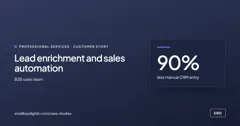
Professional Services · Read the story → - 90% less manual CRM entry
Lead enrichment and sales automation
Inbound leads enriched, scored and answered in under three minutes, with manual CRM entry down about 90% and a person in the loop.
Professional Services · Read the story → - 9 modules in one tool
Internal operations tool replacing SmartSuite
An internal tool that replaced a sprawl of tables with one shared system of record for a consulting firm.
Professional Services · Read the story →
Fewer questions waiting for you each day
Tell us the questions you answer every day. We will show you which ones a system could answer instead, and what it costs to build.
Book a founder call
What we leave out of scope
- Building your product. We build the operations around it.
- A one-off chatbot with nothing behind it.
- Businesses without a repeatable process yet. It needs writing down before it can be automated.
Terms, in plain English
- System of record
- The one place a fact about a customer, order or job is kept, which other tools read from.
- Agent
- An AI step that reads, decides within set limits and acts, with a person reviewing anything outside them.
- Automation Audit
- SBD's fixed-price review of how work is done, with findings ranked and each fix priced.
What people in this role ask us
I do not have time for a long project. How much of my time does this take?
A few hours in the audit, mostly one conversation about how the business runs, then short reviews at the end of each two-week sprint. We work with your team for the detail.
Should I hire an operations person instead?
Often you need both. Automation removes the copying and chasing, so the person you hire spends their time on judgement rather than data entry.
What if we change direction in six months?
Everything is built in tools you own and documented, so it can be changed by us, by your team or by another builder.
What does it cost?
The audit is $500, credited to the build. Builds start at $1,000 for workflow automation and $3,000 for internal tools, with the fixed price set after the audit. Care plans start at $50 a month.
Reading
-
 Strategy
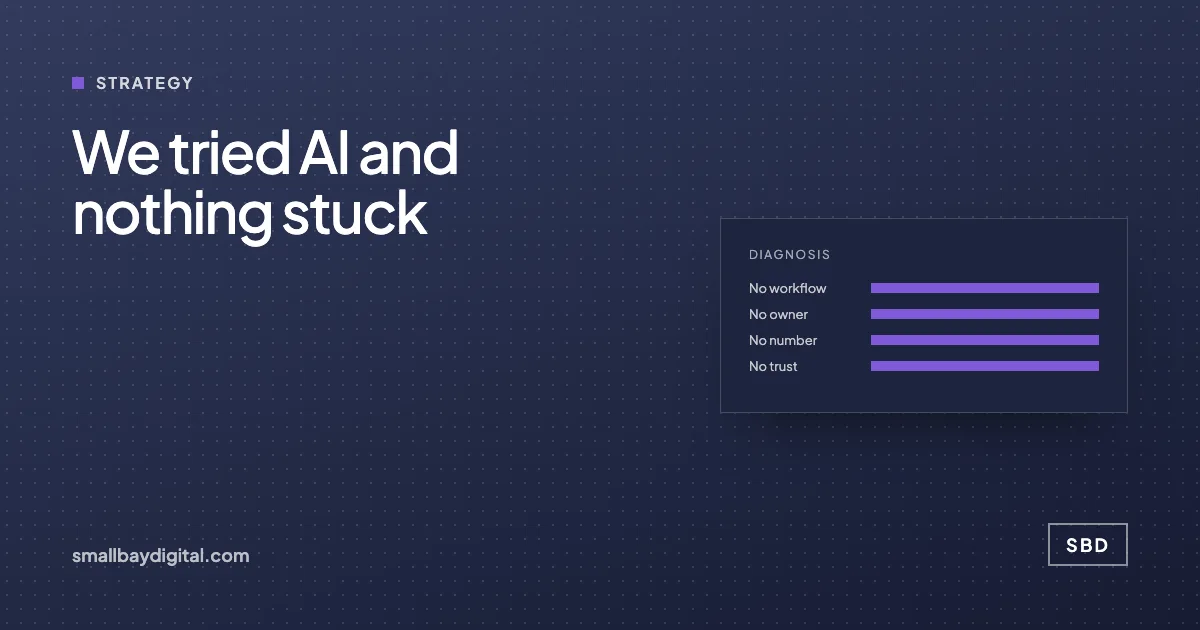
We tried AI and nothing stuck
The sentence we hear on most first calls is rarely about the AI. Four reasons small companies abandon tools, and the change that makes the next try stick.
-
 Strategy
Task automation vs AI systems: how they differ
What task automation and AI systems each are, when each one fits, and how their cost and risk differ, with the five layers an AI system needs.
-
 Checklist
AI readiness checklist: a ten-point self-assessment
Score your business on ten yes-or-no questions across data, process, tools, team and strategy, then see whether to build now or fix foundations.
Related
- Function
Leadership
Each morning we pull the numbers you run the company on from the systems that hold them, with a short note on what changed.
- Function
Operations
Each order is entered once and moves through the business on that record, and the warehouse, the customer and finance hear about each change from the same event.
- Industry
Professional services
An intake form leads to a signed engagement letter, clients get scheduled reminders for the documents they owe, and each deadline is tracked against its matter.
- Role
COOs and heads of operations
You are measured on throughput, cost and the things that did not go wrong. We find where the hours go, fix the worst of it at a fixed price, and hand you something you can govern.
- Role
Heads of sales and RevOps
You are measured on pipeline, conversion and forecast accuracy, and all three depend on a CRM nobody wants to update. We write activity to the CRM from email, calls and forms, and trigger follow-ups from deal events.
By role: COOs and heads of operations, CFOs and finance directors, Heads of sales and RevOps, Heads of customer support, CIOs and IT leads, HR and people leads, Marketing leads
Related to this page
- GuideHow to put an AI agent into production safely
- GuideHow much does AI automation cost? Prices and running costs
- ArticleMoving off OpenAI Agent Builder before 30 November
- BuildWhatsApp product promotion and catalogue chatbot
- Customer storyProperty operations automations and agent fleet
- IntegrationHubSpot and Airtable Automation
An audit of the founders and CEOs work your team still does by hand
The audit takes one to two weeks. We map the workflows, put an hours-a-week figure on each, and give you a costed blueprint in order of payback. The audit is credited in full to the build.
- Week 1 to 2Audit. We sit with the people who do the work and map it.
- Week 3Blueprint, with a fixed scope and price and the first build chosen by payback.
- Week 4 onBuild in two-week sprints, working software every second Friday.
- After go-liveSixty days of hypercare, then a care plan or run it yourself.