By industry: Construction and trades
Automation for construction firms and trades
Quotes go out while the customer is still interested, and jobs and crews sit on one board. Site reports, photos and variations are filed against the job, so invoices are raised from progress instead of from memory.
- First workflow live
- Enquiry to draft quote, usually inside the first sprint
- Usually owned by
- Owners and directors of construction and trade firms
- Built on
- Google Workspace, Microsoft 365, WhatsApp Business API
- Judged on
- Time to quote and Unbilled variations
Construction automation means enquiries turned into quotes from your rates, jobs and crews scheduled on one board, site reports, photos and variations captured on a phone and filed by job, and invoices or progress claims raised from completed work. SBD builds this around your accounting and job tools, starting with a $500 audit credited to the build.
Where the hours go in construction and trades
Usually brought in by Owners and directors of construction and trade firms, Operations and contracts managers or Estimators and quantity surveyors.
Tick what is true for your team
Most teams that bring us in tick two or more.
- 01
Quotes take too long
Measurements, rates and supplier prices are pulled together by hand, so quotes go out days later and the customer has already accepted someone else.
- 02
The schedule lives in one head
Which crew is on which site, what materials arrive when and who is off on Friday are all held by one person and a whiteboard.
- 03
Site information stays on site
Daily reports, photos and snag lists sit in phones and chat groups. When a dispute comes up, finding the evidence takes a day.
- 04
Variations are not recorded
Extra work is agreed on site and never written down, so it is not invoiced, or it is invoiced and disputed.
- 05
Invoicing lags the work
Progress claims and final invoices wait for the office to catch up, and cash flow suffers on every job.
- 06
Compliance paperwork piles up
Risk assessments, permits, certificates and subcontractor insurance expire or go missing until an inspector or main contractor asks for them.
What we build for construction and trades teams
Pick one to see what it does and the event that sets it off.
Enquiry to quote
Enquiries captured from the website, email and calls, priced from your rate sheet and supplier prices, and a draft quote prepared for an estimator to check and send.
Job and crew scheduling board
Every job, crew and delivery on one board, with clashes flagged and crews told by WhatsApp where they are tomorrow.
Site reports from a phone
A simple form for daily reports, photos, snags and hours, written straight to the job record and searchable later.
Variation capture and sign-off
Extra work logged on site with photos, priced, and sent to the customer to approve before it is done.
Progress invoicing
Completed stages and approved variations raise the invoice or progress claim in your accounting system, with reminders on overdue balances.
Compliance and document tracker
Permits, certificates, inductions and subcontractor insurance tracked by expiry, with reminders before anything lapses.
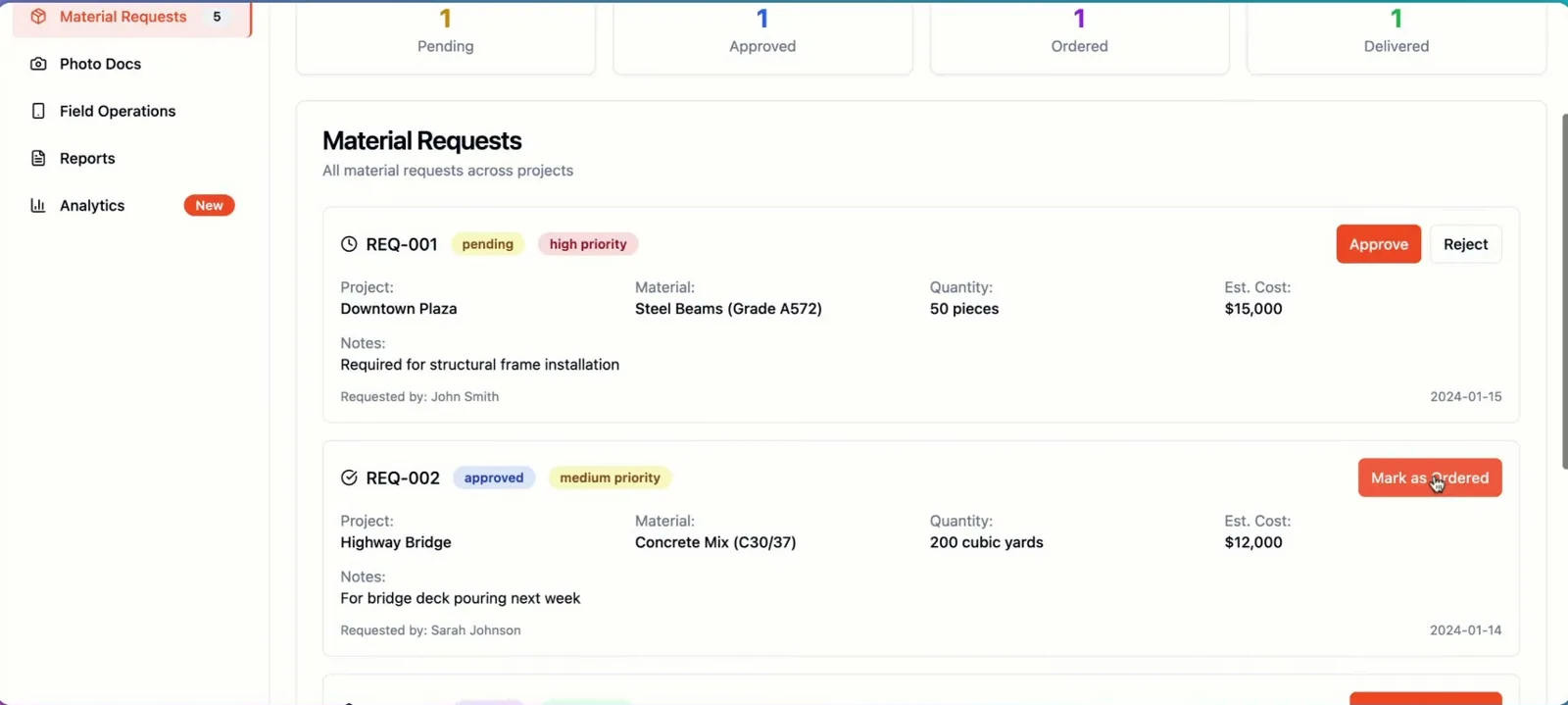
How a construction and trades build is judged
Each build has a target written into the blueprint, measured the same way before and after.
-
Time to quote
BeforeDays after the visit AfterDraft ready the same dayTime from enquiry or site visit to quote sent
-
Unbilled variations
BeforeUnknown AfterLogged and approved before workVariations recorded on site against variations invoiced, per job
-
Days to invoice
BeforeWeeks after the stage AfterDays after the stageTime from stage completed to invoice or claim sent
-
Expired documents
BeforeFound at inspection AfterRenewed before expiryPermits, certificates and insurance past expiry, per month
How construction and trades changes from 10 people to 1,000
- 1 to 10people
The owner quotes in the evening, runs the crew in the day and invoices at the weekend.
- 11 to 50people
Several crews and live jobs, a whiteboard schedule, and site photos spread across everyone's phones.
- 51 to 200people
Contracts managers, subcontractors and an office team, with variations and compliance paperwork slipping between them.
- 201 to 1,000people
Many sites at once, separate systems per division, and month-end reporting assembled by hand.
Plugs into what you already run
Anything with an API or a database we can read works the same way.
- Your job management system
 Google Workspace
 Microsoft 365
 WhatsApp Business API
- QuickBooks
 Xero
 Zoho Books
 Supabase
 Retool
 n8n
Documents it produces from each record
Built for the tax rules you file under: VAT, sales tax or GST.
- Enquiries and quotes
- Job schedules and crew sheets
- Daily site reports and photos
- Variations and change approvals
- Invoices and progress claims
- Permits, certificates and subcontractor insurance
Case studies from similar builds
-
Enquiry and quotation platform on SAP
An enquiry and quotation platform for a distributor. The pattern, enquiry in, priced from rates, draft quote checked by a person, is the same one behind construction quoting. We have not built this for a construction firm yet.
Distribution · Read the story → - 60% less manual admin
Lightweight project management system
A lightweight project management system for a services business, the same shape as a job board with stages, owners and deadlines.
Professional Services · Read the story →
What we leave out of scope
- Structural, engineering or safety sign-off. People with the right qualifications make those calls.
- Replacing specialist estimating or BIM software. We connect to it where it has an API.
Construction and trades terms, in plain English
- Variation
- A change to the agreed scope of work, usually extra work, that should be priced and approved before it is done.
- Progress claim
- An invoice for work completed to date on a staged job, rather than a single final invoice.
- Snag list
- A list of defects or unfinished items found at inspection that must be fixed before handover.
What people ask about construction and trades automation
Do you replace our job management software?
No. If you already run a job management or accounting tool that works, we connect to it through its API and fill the gaps around it. If you run on spreadsheets and chat groups, we can build a light job board in your own accounts.
Will crews use it on site?
Only if it is quicker than what they do now. Site forms are a few taps on a phone, photos attach directly, and crews can keep using WhatsApp for updates that we read and file.
Can it price quotes on its own?
It prepares a draft from your rate sheet, measurements and supplier prices. An estimator checks and sends it. Nothing goes to a customer without a person approving it.
Does this work for trades as well as builders?
Yes. Electricians, plumbers, fit-out firms and builders share the same pattern: enquiry, quote, schedule, site record, invoice. The forms, stages and wording are yours.
How long until the first part is live?
Site reports and the scheduling board are usually live inside the first two-week sprint. Quoting takes longer because the rate sheet has to be set up properly first.
Reading
-
 Systems
How much should an AI agent be allowed to do?
An agent with an unscoped token dropped a production database and its backups in nine seconds. Our rule: read widely, write narrowly, cap spend, escalate.
-
 Systems
Invoice intake with an agent: the first thirty days
The first month of an invoice intake agent from the inside: how the queue behaves, which invoices escalate, and the three settings that decide whether it lasts.
Related
- Function
Operations
Each order is entered once and moves through the business on that record, and the warehouse, the customer and finance hear about each change from the same event.
- Function
Finance and accounting
Invoices go out from the event that earned them, reminders follow the due date, and the numbers are current before month end.
- Function
Compliance and risk
We record the audit trail while the work happens, so preparing for an audit means running a report.
- Industry
Professional services
An intake form leads to a signed engagement letter, clients get scheduled reminders for the documents they owe, and each deadline is tracked against its matter.
By industry: Manufacturing, Distribution and logistics, Consulting and agencies, Service and e-commerce, Healthcare, Real estate, SaaS, Professional services, Retail and wholesale, Lending, insurance and financial services, Nonprofits and charities, Education and training, Hospitality and travel
Related to this page
- GuideHow to automate accounts payable invoice processing
- Customer storyOrder and dispatch management system
- BuildWhatsApp product promotion and catalogue chatbot
- IntegrationWhatsApp Business API and Zoho Books Automation
- IntegrationRetool and Supabase Automation
- Customer storyProperty operations automations and agent fleet
The site to invoice starter
Thirty days to quotes out faster, one schedule everyone can see, and site work that turns into invoices.
- Week 1 to 2audit of quoting, scheduling, site records and invoicing with hours and quote times measured
- Week 3blueprint, first build chosen by payback, usually site reports or the scheduling board
- Week 4 onscheduling board, site reports, variation sign-off, progress invoicing, document reminders
- Accounts in your name, training for the office and crews, sixty days of hypercare