Invoice intake is the workflow we are asked about most, because every business has it and nobody enjoys it. An email arrives with a PDF, or a photo of a PDF, or a forwarded chain with the PDF three levels down. Someone opens it, types the supplier, the date, the total and the lines into the accounting system, and files it, two hundred times a month.
This is what the first thirty days look like when an agent takes it over. It is written from the builds we have done this year, in distribution and manufacturing, and it is the shape we now plan for.
The short answer
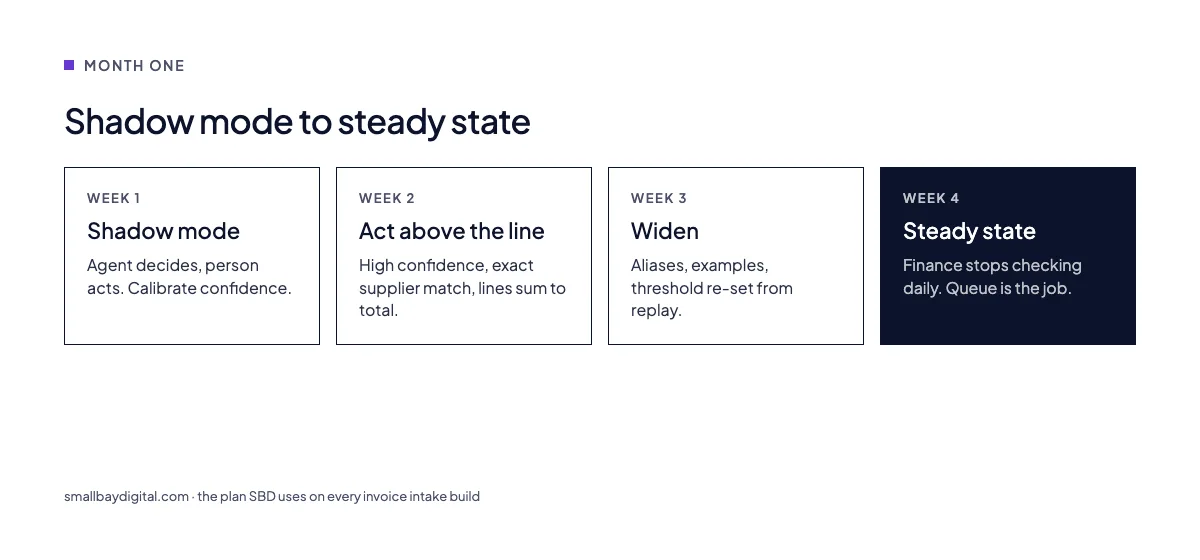
Month one has four phases: a week of shadow mode where the agent decides and a person acts, a week of the agent acting on high-confidence invoices only, a week of widening, and a week of steady state. Expect a high escalation rate early that falls as the prompt learns your suppliers. The three settings that decide whether it survives: a validation rule that line items must sum to the total, per-supplier confidence tracking, and a review queue the finance team likes using.
Week one: shadow mode
The agent reads every invoice email, extracts supplier, invoice number, date, currency, total and line items, matches the supplier against the supplier table, and writes its proposed record to a staging table with a confidence score. It does not touch the ledger.
The finance person does the job as before, and once a day compares. This week exists to calibrate two things: what the agent gets wrong, and what confidence it reports when it is wrong. Both are logged.
Typical findings in week one:
- Supplier matching fails on trading names versus legal names. We add aliases to the supplier table.
- Scans and photos extract worse than native PDFs. We add an image preprocessing step.
- One or two suppliers use a layout the agent misreads. We add examples to the prompt.
Nothing is live yet, and the team has a list of fixes.
Week two: act above the line
The agent now posts invoices to the ledger when three things are true: confidence is above the threshold set from week one, the supplier matched exactly, and the line items sum to the total within rounding. Everything else goes to the review queue with the extraction and the reasoning attached.
Early in week two most invoices still escalate, because the threshold is set cautiously. That is fine. The finance person is now reviewing a pre-filled record rather than typing one, which is already most of the time saved.
Week three: widen
Each escalated invoice is a lesson. The person corrects it in the queue and the correction is logged against the supplier. By the end of week three the prompt has examples for the awkward suppliers, the alias table is complete, and the threshold is re-set from the replay of three weeks of decisions.
The escalation rate falls sharply here. If it does not, something upstream is wrong, usually a supplier whose invoices vary every time, and that supplier gets a permanent manual flag rather than endless tuning.
Week four: steady state
The finance person stops checking the ledger daily. The signal that they have stopped is the point of the whole exercise. The review queue is now the job, and it is a fraction of the old one.
Three monitors are live by now:
- Outcome count. Invoices posted per day, with an alert when it goes quiet.
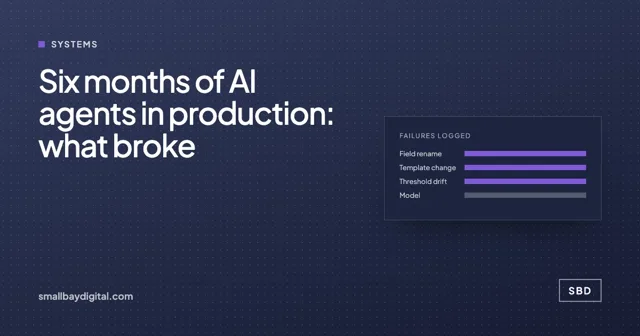
- Per-supplier confidence. One supplier’s score dropping means they changed their template. We have had this happen in month three.
- Arithmetic. Lines must sum to total. A mismatch or an absence always escalates. This one rule catches more than any prompt change.
Before and after
| Before | After month one | |
|---|---|---|
| Per invoice | Open, read, type, file | Review only the escalated ones |
| Who types | The finance person | Nobody |
| Where errors surface | At reconciliation | In the queue, before posting |
| Supplier changed template | Typed wrong for weeks | Flagged on the first invoice |
What it costs to run
An extraction call is a fraction of a cent. Two hundred invoices a month is a few dollars of model cost. The real cost is the build, the staging table, the queue, the monitors and the four weeks of tuning. That is a fixed-price build, usually inside one sprint, with sixty days of hypercare that covers the tuning described above.
Questions we get asked
What about approvals?
The agent posts to the ledger as a draft or to a staging table. Your existing approval flow stays. We are removing the typing, and people keep control.
Does it work with Tally, Xero, QuickBooks, Zoho Books?
Yes. Only the write step differs. We have shipped against each.
Our invoices come by WhatsApp and post.
WhatsApp works the same as email. Post means someone scans it, and the photo path handles the rest.
Sources and further reading
- Tally and Airtable automation, one of the integrations this pattern uses
- Order and dispatch management system, a build where invoices are generated automatically at dispatch
- How much should an AI agent be allowed to do?, the permission model for the agent step
- Six months of AI agents in production: what broke, including the supplier template change
- The silent failure: when your n8n workflow succeeds but does nothing, n8n community