By role: Heads of customer support
AI and automation for heads of customer support
You are measured on response time, resolution and satisfaction, with a team that spends its day on questions a system could answer. We help you take those off the queue while your agents keep the conversations.
- First workflow live
- AI ticket triage, usually inside the first sprint
- Usually owned by
- Heads of support with 3 to 50 agents
- Built on
- Zendesk, Freshdesk, Intercom
- Judged on
- First response time and Avoidable contact
A head of support uses automation to classify and route tickets, put order and account context on the conversation, draft replies for agents to send, and tell customers about status changes before they ask. SBD audits your queue first, builds inside your existing helpdesk, and keeps a person on each reply until measured accuracy justifies more.
Where the hours go
Usually brought in by Heads of support with 3 to 50 agents, Customer experience leads who own CSAT and SLAs or Support managers promoted from the queue and still answering tickets.
Tick what is true for your team
Most teams that bring us in tick two or more.
- 01
Your week is the queue
Monday is the weekend backlog, Thursday is the SLA report, and in between you are covering shifts and answering tickets yourself.
- 02
You report the numbers but another team owns the cause
Response time slips because of a late dispatch or a billing error upstream. Support takes the contact; another team owns the fix.
- 03
Every AI pitch wants to replace your agents
You want help with the repetitive half of the queue. A bot that answers wrongly in your brand voice tends to be switched off a month later.
- 04
Changes wait for someone else
A new routing rule or a field from the order system means a request to IT or engineering, and support is rarely first in their backlog.
What we build for heads of customer support
Pick one to see what it does and the event that sets it off.
Triage you can audit
Each ticket is classified by type, urgency and sentiment with a confidence score. You set the line, review decisions in a log and can move the line yourself.
Order context on the ticket
Order, invoice, delivery and account history pulled into the helpdesk so agents stop opening tabs and new starters reach full speed sooner.
Status messages before the customer asks
Status messages sent on dispatch, delay and refund events, so fewer customers need to raise a where-is-my-order ticket.
A weekly report on causes
Contact volume broken down by reason and by the upstream team that caused it, so the conversation with operations or product starts from a number.
How each build is judged
Each build has a target written into the blueprint, measured the same way before and after.
-
First response time
BeforeHours on busy days AfterMinutes for routed ticketsMedian time from ticket creation to first reply, from your helpdesk reports
-
Avoidable contact
BeforeStatus questions a large share of volume AfterA small share, fallingTickets tagged as status or where-is-my-order, per week
-
Handle time
BeforeLong, with tab switching AfterShorter, with context on the ticketMedian time from first open to resolution per ticket type
-
Triage accuracy
BeforeNot measured AfterMeasured weeklyShare of auto-routed tickets that were not reassigned, from the decision log
How the job changes from 10 people to 1,000
- 1 to 10people
You are the head of support and half the team, so the hours you spend on tickets come out of fixing why they arrive.
- 11 to 50people
A real queue, a helpdesk with default settings, and routing that depends on who is online.
- 51 to 200people
Several queues and shifts, SLAs reported to leadership, and the order data in a system your agents cannot open.
- 201 to 1,000people
Several channels and regions, a governance review for each AI change, and a pilot that has to prove itself before it is extended.
Case studies from similar builds
- 40% less manual time
Order and dispatch management system
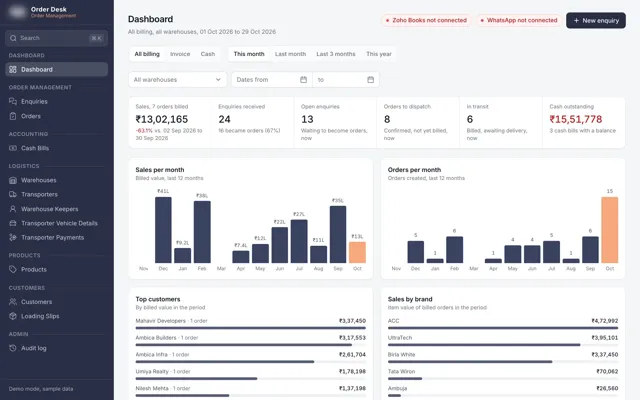
WhatsApp updates on each order change for a building materials supplier, replacing the calls that used to ask where an order was.
Distribution · Read the story → - 30% faster order processing
Retailer catalogue and order portal
A gated retailer portal with live order status and WhatsApp updates for a wholesale jeweller, with client enquiries down by about half.
Distribution · Read the story →
Review a week of tickets with us
We will sort it with you by reason and by cause, and show you which tickets a system should answer, which it should prevent, and which need your team.
Book a queue review
What we leave out of scope
- A chatbot that answers customers unattended from launch.
- Replacing your helpdesk. We build inside the one you have.
- Outsourced agents. We build the systems and your team keeps the conversations.
Terms, in plain English
- Avoidable contact
- A ticket that would not exist if the customer had been told something at the right moment.
- Confidence line
- The score above which the system acts on its own and below which it asks a person.
- Decision log
- A record of each classification and routing choice the system made, with its score, so accuracy can be checked.
What people in this role ask us
Will this reduce my headcount?
That decision stays with you. Most heads of support use the time to cover more hours, more channels or more complex work with the same team. We report what the automation handles so you can plan with real numbers.
Who controls what the AI is allowed to do?
You do. The confidence line, the categories it may route on its own and anything it may send unattended are settings you own, with a weekly sample to review. By default a person sends each reply.
How does an engagement run with a support lead?
It starts with the Automation Audit at $500, credited to the build: we read a week of your tickets with you and size what can come off the queue. Builds start at $1,000, with the fixed price set after the audit. Care plans from $50 a month keep it monitored.
We have tried a helpdesk AI add-on already.
Many teams have. The usual gap is context: the add-on sees the ticket but not the order, the invoice or the courier. We connect those systems and keep the add-on if it does its part well.
Reading
-
 Systems
How much should an AI agent be allowed to do?
An agent with an unscoped token dropped a production database and its backups in nine seconds. Our rule: read widely, write narrowly, cap spend, escalate.
-
 Strategy
We tried AI and nothing stuck
The sentence we hear on most first calls is rarely about the AI. Four reasons small companies abandon tools, and the change that makes the next try stick.
-
 Operations
Who noticed when the workflow stopped?
Most automation failures are silent: the run shows green and nothing happens for weeks. How it happens in Zapier and n8n, its cost, and the four checks we add.
Related
- Function
Customer support
Tickets arrive with the order already attached, routine questions get a drafted reply, and agents spend their time on the conversations that need a person.
- Role
Heads of sales and RevOps
You are measured on pipeline, conversion and forecast accuracy, and all three depend on a CRM nobody wants to update. We write activity to the CRM from email, calls and forms, and trigger follow-ups from deal events.
- Role
COOs and heads of operations
You are measured on throughput, cost and the things that did not go wrong. We find where the hours go, fix the worst of it at a fixed price, and hand you something you can govern.
- Industry
Service and e-commerce
One product record feeds every channel, stock comes off everywhere when it sells anywhere, and orders reach fulfilment without anyone re-typing them.
By role: COOs and heads of operations, CFOs and finance directors, Founders and CEOs, Heads of sales and RevOps, CIOs and IT leads, HR and people leads, Marketing leads
Related to this page
- Customer storyProperty operations automations and agent fleet
- Customer storyLead enrichment and sales automation
- IntegrationBotpress and Zendesk Automation
- IntegrationFreshdesk automation
- BuildBrand, architect and quotation management on SmartSuite
- GuideHow to automate accounts payable invoice processing
An audit of the heads of customer support work your team still does by hand
The audit takes one to two weeks. We map the workflows, put an hours-a-week figure on each, and give you a costed blueprint in order of payback. The audit is credited in full to the build.
- Week 1 to 2Audit. We sit with the people who do the work and map it.
- Week 3Blueprint, with a fixed scope and price and the first build chosen by payback.
- Week 4 onBuild in two-week sprints, working software every second Friday.
- After go-liveSixty days of hypercare, then a care plan or run it yourself.