

















By industry: Retail and wholesale
Retail and wholesale automation, built around how you sell
Trade orders from WhatsApp, email and phone land in one queue, and the shop, website and warehouse share one stock number. Reorders are drafted before a best seller runs out, and customers get a message when their order ships.
- First workflow live
- WhatsApp trade order capture, usually inside the first sprint
- Usually owned by
- Owners and managing directors
- Built on
- Shopify, WooCommerce, QuickBooks
- Judged on
- Order entry time and Oversells and stockouts
Retail and wholesale automation means trade orders captured once from WhatsApp, email or a portal, stock kept in step across shop, website and warehouse, reorders raised from sales, and invoices and customer updates sent from one event. SBD builds this around your POS, ecommerce and accounting systems, starting with a $500 audit credited to the build.
Where the hours go in retail and wholesale
Usually brought in by Owners and managing directors, Operations and warehouse managers or Buyers and merchandisers.
Tick what is true for your team
Most teams that bring us in tick two or more.
- 01
Trade orders arrive everywhere
Retailers and stockists order by WhatsApp, phone, email and in person. Someone retypes each one, and the order that came in at 9pm is found the next afternoon.
- 02
Stock disagrees between channels
The shop, the website and the marketplace each think they hold a different number, so items sell twice or sit hidden while customers are told they are out.
- 03
Reordering is a guess
Buyers reorder from memory or a weekly walk round the shelves. Best sellers run out and slow lines tie up cash.
- 04
Customers chase for updates
Where is my order, is it in stock, when will it ship. These get answered by hand all day, by the people who should be packing.
- 05
Price lists and catalogues drift
Trade prices, retail prices and the catalogue live in separate files. A change in one is missed in another, and margin leaks quietly.
- 06
Credit and collections run on memory
Trade accounts buy on terms, but overdue balances are chased when someone remembers, and new orders ship to accounts that are already over their limit.
What we build for retail and wholesale teams
Pick one to see what it does and the event that sets it off.
One order inbox for trade customers
Orders from WhatsApp, email, phone notes and a trade portal read, matched to the customer and products, and written to one queue, with anything unclear sent to a person to check.
Stock sync across channels
Shop, website, marketplaces and warehouse kept in step from the same stock record, so a sale anywhere updates everywhere.
Reorder flags from real sales
Sales velocity and lead times turned into a reorder list per supplier, with purchase orders drafted for a buyer to approve.
Trade catalogue and order portal
Approved retailers browse live stock at their own prices, place orders and see status, without a sales call.
Order updates on each status change
Confirmation, dispatch and delivery messages by WhatsApp or email, triggered when the order is confirmed, packed or delivered.
Credit limits and payment reminders
Overdue balances chased on a schedule you set, and orders from accounts over their limit held for approval before they ship.
How a retail and wholesale build is judged
Each build has a target written into the blueprint, measured the same way before and after.
-
Order entry time
BeforeEvery order retyped AfterCaptured once, exceptions checkedMinutes from order received to order in the system
-
Oversells and stockouts
BeforeFound by the customer AfterFlagged before they happenOrders cancelled for no stock, and best sellers out of stock, per month
-
Status enquiries
BeforeAnswered by hand AfterMostly answered by the updateWhere-is-my-order messages per week
-
Overdue trade balances
BeforeChased when remembered AfterChased on scheduleValue of trade debt past terms, per month
How retail and wholesale changes from 10 people to 1,000
- 1 to 10people
The owner takes orders on their phone, counts stock by eye and does the books at the weekend.
- 11 to 50people
A shop, a website and a few trade accounts, each with its own stock number and its own spreadsheet.
- 51 to 200people
Several stores or a warehouse, a buying team working from exports, and customer service answering the same questions all day.
- 201 to 1,000people
Many branches and channels, central buying, and a reporting team reconciling numbers that rarely agree.
Plugs into what you already run
Anything with an API or a database we can read works the same way.
- Your POS system
- Shopify
 WooCommerce
- QuickBooks
 Xero
 Zoho Books
 WhatsApp Business API
 Google Workspace
 Supabase
 Retool
 n8n
Documents it produces from each record
Built for the tax rules you file under: VAT, sales tax or GST.
- Trade orders and order confirmations
- Invoices and credit notes
- Purchase orders and supplier confirmations
- Delivery notes and dispatch updates
- Price lists and trade catalogues
- Statements and payment reminders
Case studies from similar builds
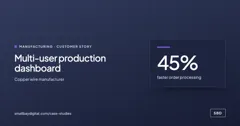
- 30% faster order processing
Retailer catalogue and order portal
A gated catalogue and order portal for a wholesale jeweller, with WhatsApp updates replacing manual customer messages. This is wholesale work we have shipped.
Distribution · Read the story → - 80% less time on product updates
Sales channel inventory sync
Inventory kept in step across sales channels, the same pattern that stops a shop and a website selling the same item twice.
E-commerce · Read the story →
What we leave out of scope
- Replacing your POS, ecommerce platform or accounting system. We build around them.
- Pricing strategy or demand forecasting models. We use your sales history to flag reorders. Pricing stays with you.
Retail and wholesale terms, in plain English
- Reorder point
- The stock level at which a new order should be placed, set from typical sales and the supplier lead time.
- Oversell
- Selling an item that is no longer in stock, usually because two channels hold different stock numbers.
- Trade portal
- A gated site where approved business customers see their own prices, live stock and order status, and place orders.
What people ask about retail and wholesale automation
Do you work with our POS and ecommerce platform?
We connect to systems with an API or a supported integration route, such as Shopify, WooCommerce and most modern POS and accounting tools. Where a system has no API, we work from its exports and imports. Your existing systems stay the record.
Can retailers keep ordering on WhatsApp?
Yes. Most trade customers will not change how they order, so we read orders where they arrive, match them to products and prices, and put them in one queue. A portal is offered beside it for customers who want one.
Will the system place purchase orders on its own?
Only if you want it to. By default it drafts reorders from sales and lead times, and a buyer approves them. You decide which suppliers or products, if any, can reorder without a check.
Does this work for a single shop as well as a wholesaler?
Yes. A single shop usually starts with stock sync and customer updates. A wholesaler usually starts with the order inbox and the trade portal. The audit shows which one pays back first.
How long until the first part is live?
Customer updates and the order inbox usually go live in the first two-week sprint. Both sit alongside your POS and store, so nothing there has to change.
Reading
-
 Strategy
Automation vs AI systems: what moves the number
Stacking task automations stalls at around twenty. The difference between a task and a system, the five layers that hold it up, and what to rebuild first.
-
 Operations
Who noticed when the workflow stopped?
Most automation failures are silent: the run shows green and nothing happens for weeks. How it happens in Zapier and n8n, its cost, and the four checks we add.
Related
- Industry
Distribution and logistics
Payment reminders follow the credit cycle, drivers capture proof of delivery on their phones, every channel sells from one stock count, and customers get an ETA before they ring.
- Industry
Service and e-commerce
One product record feeds every channel, stock comes off everywhere when it sells anywhere, and orders reach fulfilment without anyone re-typing them.
- Function
Operations
Each order is entered once and moves through the business on that record, and the warehouse, the customer and finance hear about each change from the same event.
- Function
Finance and accounting
Invoices go out from the event that earned them, reminders follow the due date, and the numbers are current before month end.
By industry: Manufacturing, Distribution and logistics, Consulting and agencies, Service and e-commerce, Healthcare, Real estate, SaaS, Professional services, Construction and trades, Lending, insurance and financial services, Nonprofits and charities, Education and training, Hospitality and travel
Related to this page
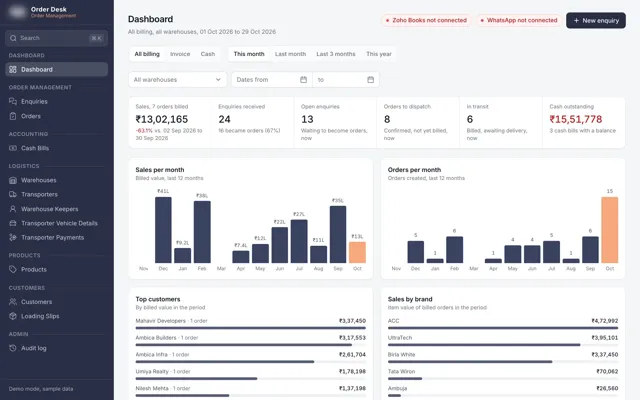
- Customer storyOrder and dispatch management system
- GuideHow to automate accounts payable invoice processing
- BuildWhatsApp product promotion and catalogue chatbot
- Customer storyProperty operations automations and agent fleet
- IntegrationShopify and QuickBooks Automation
- IntegrationWhatsApp Business API and Zoho Books Automation
The order desk starter
Thirty days to trade orders captured once, one stock number across channels, and order updates sent without anyone typing them.
- Week 1 to 2audit of orders, stock, reordering and customer messages with hours and stockouts measured
- Week 3blueprint, first build chosen by payback, usually the order inbox or stock sync
- Week 4 onorder capture, stock sync, reorder flags, customer updates, payment reminders
- Accounts in your name, training for the team, sixty days of hypercare