E-commerce · Customer story
Zero listing mismatches across three sales channels for a watch reseller
One product record feeding Shopify, eBay and Chrono24 for a growing D2C reseller, replacing manual updates on each platform and the stock mismatches they caused.
- Client
- D2C watch reseller
- Industry
- E-commerce
- What we built
- Sales channel inventory sync
- Built with
- SmartSuite, Make, Shopify, eBay
Measured after go-live
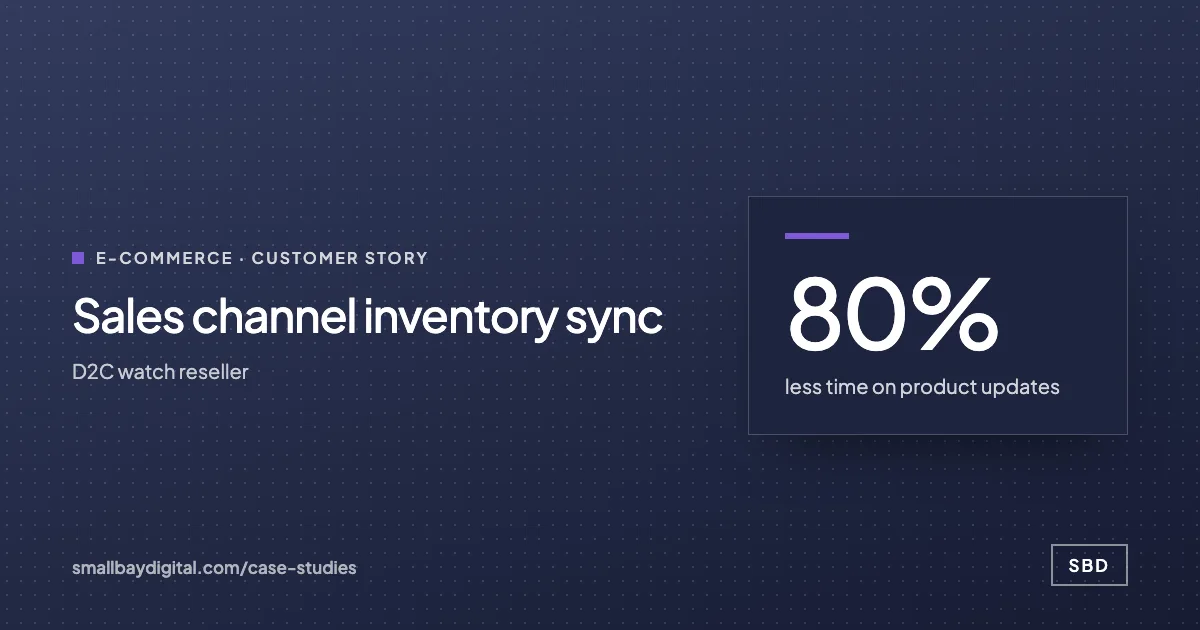
- 80%less time on product updates
Hours spent updating listings across platforms, before and after.
- 0inventory mismatches
Reported mismatches in the 90 days after go-live.
- 2xfaster launches
Under 20 minutes to launch across platforms, against two to three hours before.
A fast-growing watch reseller updated every product by hand on Shopify, eBay and Chrono24. SBD built one product record on SmartSuite that syncs to every channel with per-channel mapping. Update time fell by 80%, launches got twice as fast, and inventory mismatches dropped to zero over the following 90 days.
What changed for the team
- Each product updated separately on every channelAfter: One record, pushed to every channel
- No one record for stock or priceAfter: SmartSuite holds the truth for product and stock
- Sold items still live on other channelsAfter: A sale anywhere updates stock everywhere
- Two to three hours to launch a product everywhereAfter: Under 20 minutes to launch across all channels
“Updating listings across Shopify, eBay, and Chrono24 was a three-hour daily chore. Now it's one update in SmartSuite and everything syncs. Haven't had a mismatch in months.”
How it was built
- Map every channel
Worked through each platform's listing rules with the client team. eBay, Shopify and Chrono24 differ on titles, categories and images.
- Clean and unify
Existing listings reverse-engineered, cleaned and tagged into one schema flexible enough for new channels.
- Build the sync
SmartSuite as the master record, Make scenarios translating each change into every channel's format, with image resizing and metadata per platform.
- Close the loop
Shopify sales synced back so stock reflects real orders.
What runs now
Each workflow, the event that starts it, and what it does.
-
Product create and update
WhenA product record changes
ThenTranslated and pushed to every channel
-
Sales sync
WhenAn order is placed on Shopify
ThenStock updated in SmartSuite and on every other channel
-
Per-channel mapping
WhenA listing is pushed
ThenTitles, categories, images and metadata fitted to the platform's rules
How to sync Shopify, eBay and Chrono24 listings from one product record
Keep one master record for each product, translate it into each channel's format on the way out, and feed sales back so a sold item comes off every other channel. For this watch reseller the record lives in SmartSuite and Make does the translation. The same pattern works with Airtable or Postgres as the record and n8n as the sync.
- List every channel rule
Write down what each platform requires: title length, category, required attributes, image sizes and how stock is set. eBay item specifics, Chrono24's watch fields and Shopify's product options all need their own mapping.
- Design one schema
One product record with every field any channel needs, plus the listing ID on each channel so updates go to the right listing.
- Clean the existing listings into it
Pull the current listings from each channel, match duplicates, and tag them into the schema before anything syncs.
- Build the outbound sync
A change to the record is translated per channel: title, category, images resized to each platform, and metadata.
- Feed sales back
An order updates stock on the master record, which then updates or ends the listing on every other channel.
- Edit in one place only
The team changes products in the master record, never in a channel admin, so the record stays the truth.
What goes wrong, and how we handled it
- Overselling a one-off item. A watch is usually a single unit. If it sells on one channel and stays live on another, two customers can pay for it. The sale has to reach the other channels in minutes.
- One title for every channel. Each platform has its own length limits and search habits, so the sync builds a title per channel from the same fields.
- Edits made in a channel admin. A quick fix typed straight into eBay or Shopify is overwritten on the next sync, or drifts from the record. Edits go in the record.
Questions
Can an off-the-shelf multichannel tool do this?
Many cover Shopify and eBay well. Chrono24 support varies, so check it before you buy. If the tool cannot publish to every channel you sell on, a custom sync from your own record is the reliable route.
Which tools did you use?
SmartSuite as the product record and Make for the sync, with Shopify, eBay and Chrono24 as channels. Airtable or Postgres with n8n would follow the same steps.
What does a build like this cost?
It starts with a $500 audit that maps your channels and their rules. Workflow builds start at $1,000, at a fixed price set after the audit.






What made it work
Treating the translation layer as the main job, with one schema in the middle and each channel's rules applied on the way out.
Related solutions
- Industry
Service and e-commerce
One product record feeds every channel, stock comes off everywhere when it sells anywhere, and orders reach fulfilment without anyone re-typing them.
- Function
Marketing
Messages go out because a customer did something, lists stay in step with the CRM and the store, and you can see which spend turned into revenue.
- Function
Operations
Each order is entered once and moves through the business on that record, and the warehouse, the customer and finance hear about each change from the same event.
Projects like this start with an audit
The audit takes one to two weeks. We map the work your team still does by hand, put an hours-a-week figure on each piece, and give you a costed blueprint in order of payback. The $500 is credited in full to the build.
- Week 1 to 2Audit with the people who do the work.
- Week 3Blueprint, with a fixed scope and price and the first build chosen by payback.
- Week 4 onTwo-week sprints, working software every second Friday.
- After go-liveSixty days of hypercare. Accounts and code in your name.
More customer stories