Customer support
Zendesk integration consultant: triage, context and escalation built properly
SBD connects Zendesk to the systems your support team keeps alt-tabbing into, adds AI triage that a person can check, and redesigns triggers and fields so routing stays predictable, for teams of 1 to 1,000 people. Workflow automation builds start at $1,000, with the fixed price set after a $500 Automation Audit that is credited to the build.
- Tool
- zendesk.com
- Usually paired with
- Shopify, Slack, Jira, Linear
- Timeline
- Most builds live in 2 to 8 weeks
- Owned by
- You, with accounts, credentials and code in your name.
What we build on Zendesk
- Triage and route tickets with an AI step
- Attach order, account and billing context to tickets
- Escalate to engineering with the right context
- Report on support against revenue
What we sync
Workflows we are asked for
- Zendesk ticket triage with AI
- Order details on Zendesk tickets
- Zendesk to Jira or Linear escalation
- Zendesk CSAT into the CRM
Full write-ups of Zendesk integrations

Tools Zendesk usually needs to talk to
-
Zendesk and Shopify
The storefront for most of the e-commerce businesses we work with.
-

Zendesk and Slack
Team chat, and usually the place where alerts get read.
-

Zendesk and Jira
Issue tracking for engineering and IT teams.
-

Zendesk and Linear
Issue tracking for product teams, fast and opinionated.
-

Zendesk and Claude
Anthropic's models, used through the business API for reading, classifying, extracting and drafting.
What a Zendesk integration from SBD does
Most support teams that call us already run Zendesk well enough.
The trouble sits around it: agents open the shop, the billing system and the CRM in separate tabs to answer one ticket, escalations to engineering arrive without the facts, and nobody can say which customers are costing the most support time. We fix the plumbing around the helpdesk rather than replacing it.
The work falls into four groups. Triage: a model reads each new ticket, sets category, priority and language in dropdown fields, and suggests a reply that an agent approves. Context: order, subscription and account data written onto the ticket or shown in a sidebar app, so the agent sees it without searching. Escalation: tickets that need engineering become Jira or Linear issues with the customer, the reproduction steps and the ticket link attached, and the status flows back. Reporting: ticket data joined to revenue and account data, so support cost can be read per customer or per product.
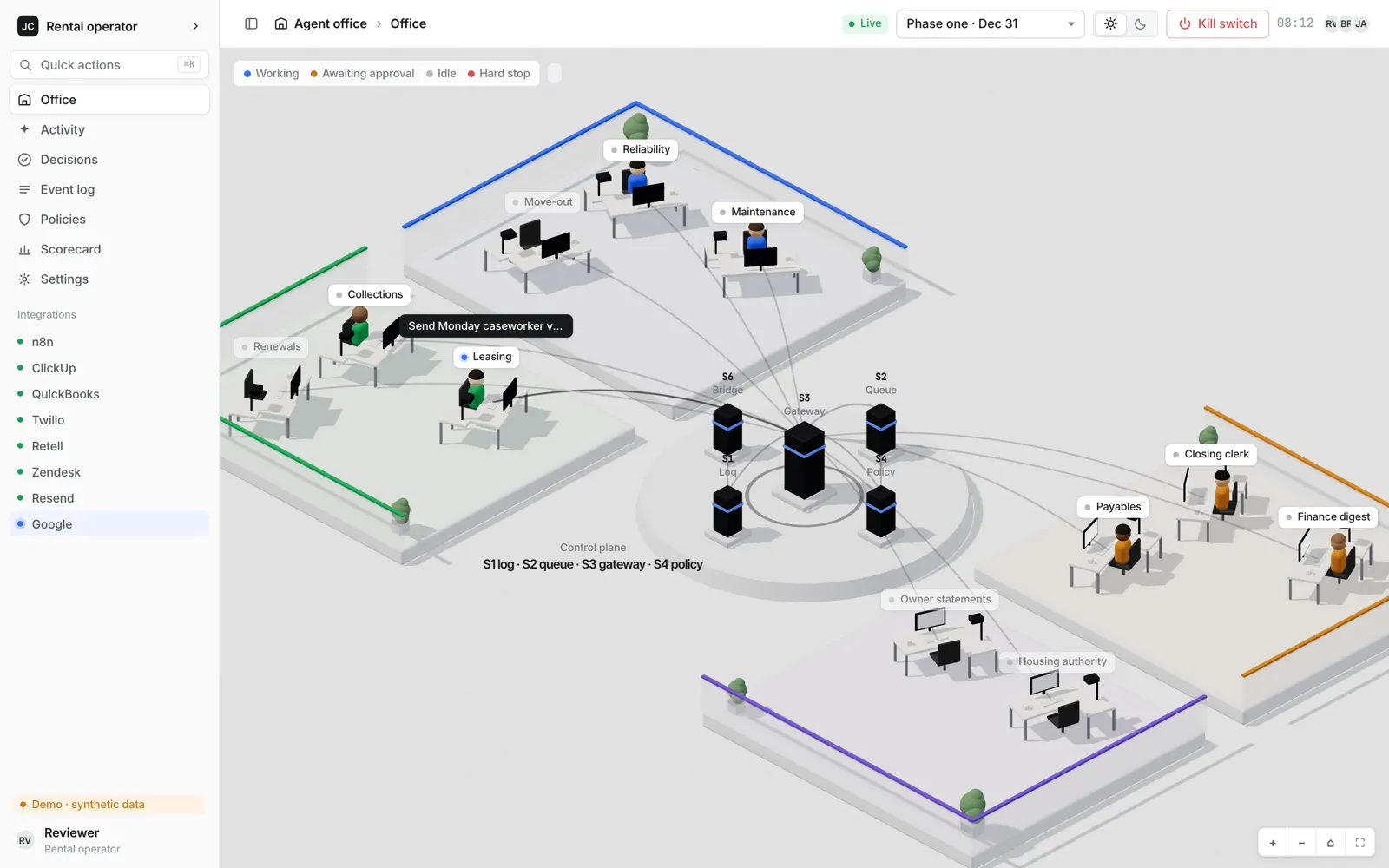
Zendesk sits in the stack of one published SBD project: the automations for a 120-property rental portfolio, alongside n8n, Twilio, ClickUp and QuickBooks. We will not invent other Zendesk clients to point you to.
When marketplace apps are enough, and when a custom integration pays
Zendesk has a large app marketplace and its own AI agents, and for a single-system lookup a marketplace app is often the right answer.
Its AI agents are included in every plan and billed per automated resolution: $1.50 each on a commitment or $2.00 pay as you go, according to its pricing page in October 2026. That is reasonable for simple, high-volume questions with a clear answer in your help centre.
A custom integration, usually built on n8n or Make, earns its cost when:
- The context an agent needs lives in two or three systems, and a marketplace app covers only one of them.
- You want AI classification and drafting with your own rules, a log of every suggestion and a person approving replies, rather than a per-resolution charge.
- Escalations must create and update issues in Jira or Linear and keep the status in sync both ways after that.
- Support data has to land in a warehouse or CRM for reporting, on a schedule you control.
Ticket field and trigger design that survives growth
Zendesk evaluates ticket triggers in the order they are listed
If a trigger updates the ticket, the cycle starts again, and each trigger acts at most once per cycle. Zendesk allows up to 7,000 active ticket triggers. Automations are different: they run hourly, can fire on at most 1,000 tickets per hour, and each one needs a condition that is true only once or an action that cancels a condition, or it keeps firing. These rules are why helpdesks that grew one trigger at a time become hard to reason about.
When we add an integration we design fields and triggers together
Anything a trigger routes on is a dropdown or checkbox field, never free text. The AI step writes its result to a dedicated field and a tag, and routing triggers read that field, so a model change never silently changes routing. Triggers are grouped into categories in a fixed order: field changes first, then assignment, then notifications. Every trigger that calls a webhook adds a tag and checks for its absence, so a ticket cannot loop. We keep a written field dictionary that says who owns each field and which system writes to it.
Zendesk API limits, authentication and webhooks
- 01
From Zendesk's developer documentation in October 2026, the Support API allows 200 requests a minute on Suite Team, 400 on Growth and Professional, 700 on Enterprise and 2,500 on Enterprise Plus. The High Volume add-on raises the limit to 2,500 a minute on Growth and above, with a minimum of 10 agent seats. Some endpoints have their own ceilings: ticket updates are limited to 30 per 10 minutes per user per ticket and 100 a minute per account, and incremental exports to 10 a minute. Offset pagination stops at 100 pages or 10,000 records, so we use cursor pagination for anything that reads history.
- 02
Zendesk now recommends OAuth access tokens and marks API tokens as deprecated, noting that an API token can impersonate anyone in the account, including admins. We register an OAuth client per integration so each one can be revoked on its own.
- 03
Webhooks have a 12-second timeout and are retried up to five times on timeout.
Delivery is best effort: Zendesk states that duplicates are possible and events can be dropped, for example when its circuit breaker trips after 70% of requests fail within five minutes. So every receiver we build verifies the HMAC-SHA256 signature in the X-Zendesk-Webhook-Signature header, answers quickly, queues the work, and treats each event as possibly repeated. A nightly reconciliation catches anything a webhook missed.
How a Zendesk engagement with SBD works
- Step 1$500Automation AuditCredited to the build
- Step 2from$1,000Workflow automationFixed after the audit
- Step 3from$3,000Internal toolsFixed after the audit
- Step 4from$50Care planA month, after sixty days of hypercare
Every engagement starts with an Automation Audit at $500, credited in full to your build. For Zendesk we review triggers, automations, ticket fields, macros and the systems agents look up during a ticket, and we sample real tickets to see where time goes. You get a ranked list of fixes with a fixed price for each, and a blueprint for the first build.
Workflow automation builds start at $1,000, internal tools at $3,000 and multi-module systems at $5,000. A typical first scope is AI triage with order context, or Jira escalation with two-way status. Work runs in two-week sprints with sixty days of hypercare, and care plans start at $50 a month. Nothing is billed by the hour; see the pricing page.
For reference, Zendesk's pricing page in October 2026 lists Suite Team at $55 and Suite Professional at $115 per agent a month billed annually, with Enterprise priced on request. A sandbox is an add-on on Professional and included on Enterprise. Your Zendesk subscription is paid by you to Zendesk; we do not resell licences.
What you own when we finish
Everything below is in your name when the build ends.
- The Zendesk account, the OAuth clients, the workflow platform and every model API key are in your name.
- You receive the field dictionary, a map of triggers and automations in firing order, and a runbook for each integration that says what it does, what failure looks like and who is alerted.
- AI replies stay as suggestions until accuracy on your own tickets justifies more, and the risky categories, such as refunds and account closures, always stay with a person.
Zendesk at enterprise scale
Larger Zendesk accounts are run by customer support, customer success and IT service teams, often with several brands, languages and agent groups in one account and a dedicated Zendesk administrator or support operations team. In larger organisations it sits next to a CRM, a billing system and an engineering tracker, and most of the friction is in how those systems talk to each other.
Change control on triggers
We build and test in a sandbox where your plan includes one, keep triggers in a documented order with categories, and release changes in a scheduled window with the previous configuration exported for rollback.
Scoped, revocable access
Each integration gets its own OAuth client with the narrowest scope it needs, instead of a shared API token that could act as any admin. Revoking one integration does not break the others.
API headroom
We size traffic against your plan's per-minute limit and the per-endpoint ceilings, use incremental exports and cursor pagination for history, and read the rate limit headers so jobs slow down before Zendesk returns 429.
AI with human approval
Classification and drafts are logged with the model's confidence. Agents approve replies, and categories that move money or close accounts never get an automatic send.
Reliable event handling
Webhook receivers verify signatures, queue work and are idempotent, because Zendesk documents that duplicates and drops can happen. A scheduled reconciliation fills any gaps.
Reporting outside Zendesk
We move ticket, satisfaction and time data into your warehouse or CRM on a schedule, joined to account and revenue data, so support cost can be read per customer.
Engagements we take on
Already on Zendesk, triggers nobody dares touch
Hundreds of triggers built over years, some contradicting each other. We map them in firing order, retire duplicates, rebuild routing on dropdown fields and hand over a document your admins can maintain.
Already on Zendesk, agents searching three systems per ticket
We bring order, subscription and account data onto the ticket from the systems that own it, with one source named for each field, so agents answer from one screen.
Already on Zendesk, escalations lost between teams
We connect Zendesk to Jira or Linear with a two-way link, so the issue carries the customer context and the ticket updates when engineering moves the issue on.
Already on Zendesk, weighing AI agents against a custom step
We compare the per-resolution cost of Zendesk's AI agents with a custom triage and drafting step on your real ticket mix, and recommend one, or a mix, with the numbers shown.
Read next
Sources
- Zendesk Developers, Rate limits (plan limits, endpoint limits, High Volume add-on), checked 29 October 2026
- Zendesk Developers, Security and authentication (OAuth, deprecated API tokens), checked 29 October 2026
- Zendesk Developers, Pagination (cursor and offset limits), checked 29 October 2026
- Zendesk Developers, Creating and monitoring webhooks (timeout, retries, circuit breaker), checked 29 October 2026
- Zendesk Developers, Verifying webhook authenticity (signature headers), checked 29 October 2026
- Zendesk Help, Creating ticket triggers (order, cycles, 7,000 active triggers), checked 29 October 2026
- Zendesk Help, About automations (hourly runs, 1,000 tickets per hour, 500 active), checked 29 October 2026
- Zendesk, Pricing page (Suite plans, automated resolutions, sandbox), checked 29 October 2026
Standards on every build
Validation, retries, reconciliation, audit logs and alerts come as standard, with credentials and accounts in your name. Read the integration standards
What people ask about Zendesk
Will the AI reply to customers?
It classifies, drafts and suggests. A person sends until accuracy on your own tickets earns more, and even then the risky categories stay with a person.
Start with the one Zendesk workflow your team still runs by hand
Bring it to a discovery call. You leave with a yes or no on fit, an outline of the build and what we would do first.
Book the call