




















The short answer
A single automation between two tools can be a few hours of your own time on a no-code platform. With an agency, the build price depends on what is being built: as one example, SBD's workflow automation builds start at $1,500, internal tools at $3,000, multi-module systems at $5,000 and customer-facing products at $10,000, with the fixed price set after an audit. Running costs are platform fees (free to a few hundred dollars a month for most small teams), model usage (cents to hundreds of dollars a month, driven by volume) and upkeep. These figures use SBD's published prices as one example, and current vendor price lists.
There is no single price for AI automation, because “automation” covers everything from a form that posts to a spreadsheet to an agent that reads and answers customer email. What you can do is split the cost into the same few lines every project has, and price each one from a list or a quote.
The cost at a glance
| Build type | One-time build (SBD, from) | Monthly running cost |
|---|---|---|
| Workflow automation, including AI agents for a defined job | From $1,500 | Platform plan, model usage and upkeep |
| Internal tool your team works in | From $3,000 | Hosting, any model usage and upkeep |
| Multi-module system: several tools on one data model, portals | From $5,000 | Hosting, model usage, platform plans and support |
| Micro-SaaS: a product your customers log into and pay for | From $10,000 | Hosting, model usage, billing and support |
Build figures are SBD’s published starting prices by build type, given as one reference point; the fixed price for a given project is set after the audit, and other suppliers will price differently. Platform and model figures come from the vendor price lists in the sources.
What the platforms charge. Zapier’s Pro plan starts at $19.99 a month billed annually for 750 tasks, with a free plan of 100 tasks. Make offers a free plan with 1,000 credits a month, with paid plans priced by credit volume. n8n’s cloud Starter plan is 20 euros a month billed annually for 2,500 workflow executions, and Pro is 50 euros for 10,000; n8n can also be self-hosted, which moves the cost to your own server and upkeep.
What the models charge. Prices are per million tokens. At the time of writing, Anthropic lists Claude Haiku 5.5 from $0.10 input and $0.50 output, Sonnet 5.5 at $2 and $10, and Opus 5.5 at $4 and $20. OpenAI’s list runs from $0.05 input on its smallest model to $30 input and $180 output on its pro models. The spread is wide, so model choice matters more than almost any other running cost.
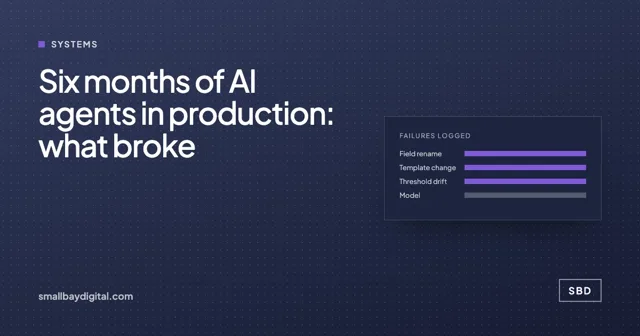
Upkeep. Systems break when a connected tool changes its API, a field is renamed, or the data drifts. Budget for someone to watch and fix them. As one example, SBD’s care plans start at $50, $150 and $300 a month by tier.
What drives the price
- Number of systems. Each connection adds authentication, error handling and testing.
- Data quality. Clean, consistent data is quick to automate. Duplicates and free text are not.
- Older systems without an API. Screen scraping, exports or a database bridge cost more to build and to keep running.
- How much judgement is involved. Rules are cheap. Reading, classifying and drafting need a model, evaluation and a review step.
- Risk of being wrong. Anything that touches money, customers or personal data needs approvals, logging and access controls.
- Volume. Usage pricing on platforms and models grows with every item processed.
- Who builds it. Your own time, a freelancer or an agency, each with different rates and different things included.
Hidden costs
- Your team’s time. Explaining the process, testing, and changing how people work is real cost, even when no invoice arrives.
- Retries and long inputs. Failed runs repeat tasks, and long documents use far more tokens than the average.
- Plan jumps. Crossing a task or credit limit can move you up a tier mid-year. Zapier’s monthly billing costs about 50% more than annual on the same tier.
- Extra seats and licences. A new tool in the workflow may need paid users.
- Maintenance. Nobody owning failures is the most common reason automations quietly stop.
- Switching cost. If the accounts and code sit with your supplier, changing supplier means rebuilding.
1. Define the job and the volume
Name one process, the systems it touches and how many items it handles a month: invoices, leads, tickets, orders. Take the count from a system report. Every later number multiplies by it.
2. Price the platform
Map each step to how the platform counts usage: tasks on Zapier, credits on Make, executions on n8n. Multiply by monthly volume, add at least 30% headroom, and pick the tier that covers it. Compare annual and monthly billing.
3. Price the model usage
Run ten real examples through the model and note input and output tokens. Then:
Monthly model cost = items a month x (input tokens x input price + output tokens x output price) / 1,000,000
For example, 10,000 items at 1,000 input and 500 output tokens each is 10 million input and 5 million output tokens. On Claude Sonnet 5.5 at list price that is $20 plus $50, about $70 a month. On Claude Haiku 5.5 it is about $3.50. Test the cheaper model first; it is often good enough for classification and extraction.
4. Price the build
Ask for a fixed price against a written scope, with exclusions listed. Check that testing, documentation, handover and a period of fixes after launch are included. If you build it yourself, count your hours at what they are worth.
5. Add upkeep and contingency
Add a monthly line for monitoring and small changes, and name who is called when it fails. Add 10% contingency to one-time costs.
6. Compare against the cost of doing nothing
Set the first year’s total against the hours, errors and delays the automation removes. The free ROI calculator does this with any pricing model, and our guide to building an automation business case covers the method in full.
Build or buy
If an off-the-shelf product already does the job for a monthly fee, it is usually cheaper than a custom build, at least to start. Custom work earns its cost when the process is specific to you, spans several systems, or the subscription grows with headcount faster than the value does. The free build vs buy tool walks through the trade-off.
When it is not worth it
- Low volume. A task done a few times a month rarely repays a build.
- A process that changes every month. Fix the process first, then automate it.
- No owner. If nobody will look after it, it will fail without anyone noticing.
- Cheaper fixes exist. A template, a form or a setting in a tool you already pay for may solve most of it.
If the numbers do not work, that is a useful answer. Spend the budget where they do.
Checklist
0 of 12 done
Ticks are saved in this browser only.
Sources
- ZapierPlans and pricing
- MakePricing
- n8nPricing
- OpenAIAPI pricing
- AnthropicClaude pricing
- SBDPricing
Questions
How much does an AI agent cost?
The build is usually the larger cost: an agent that drafts, triages or answers within a defined job is priced like any other build: SBD's start at $1,500 as workflow automation, with the fixed price set after the audit. Running costs are model usage, which at current list prices can be a few dollars to a few hundred a month depending on volume and model, plus platform fees and upkeep.
What does model usage cost per month?
Multiply tokens per item by items per month by the price per million tokens. As an example, 10,000 items at 1,000 input and 500 output tokens each comes to about $70 a month on Claude Sonnet 5.5 at list price, and about $3.50 on Claude Haiku 5.5. Check the price list on the day you estimate.
Is Zapier, Make or n8n cheapest?
It depends on volume and how each counts usage. Zapier charges by task, Make by credit and n8n by workflow execution, so a workflow with many steps can be cheap on one and expensive on another. Price your own workflow on each, at your real volume.
Why do agency quotes vary so much?
Scope, number of systems, data quality, whether older systems have an API, and what is included: testing, documentation, handover and support after launch. Ask every supplier for a fixed scope with exclusions written down, so you compare like with like.
Do we pay for the software as well as the build?
Usually yes. Platform subscriptions and model usage are billed to your accounts by the vendors, separately from the build. Make sure the accounts are in your name, so you keep them if you change supplier.