





















The short answer
The build cost depends on what the agent touches and who sees its output. As one reference point, SBD's agent builds start at $1,500, and the fixed price is set after the audit. Running costs are model tokens (often a few dollars to a few hundred a month), hosting, monitoring, the time people spend reviewing its work, and upkeep. The review time and upkeep usually cost more than the tokens.
This guide goes deeper on agents than our broader guide to what AI automation costs, which covers platforms, simple workflows and build versus buy. Here the focus is what makes an agent different: it calls the model many times per run, it uses tools, and it needs guardrails, evaluation and people to check it.
Build cost by agent type
| Build type the agent sits in | Example | One-time build (SBD, from) |
|---|---|---|
| Workflow automation | Triage or drafting agent that reads, looks things up and updates tools | From $1,500 |
| Internal tool | Agent inside a screen your team works in, with approvals | From $3,000 |
| Multi-module system | Agents across several tools on one data model, portals alongside | From $5,000 |
| Micro-SaaS | Customer-facing chat or voice agent inside a product customers pay for | From $10,000 |
These are SBD’s published starting prices by build type, one supplier’s view; the fixed price for a given agent is set after the audit. Other suppliers will price differently, so treat them as a way to place your project rather than a market average. What moves an agent up the table is exposure: the more it can change, and the more people outside your business see its output, the more testing, approvals and monitoring it needs.
Running costs
Model tokens
An agent rarely makes one model call. A typical run plans, calls a tool, reads the result, decides, and writes. Each call resends the instructions, the tool definitions and the history so far, so input tokens dominate.
Monthly token cost = runs a month x calls per run x (input tokens per call x input price + output tokens per call x output price) / 1,000,000
A worked example: 2,000 runs a month, six calls per run, 3,000 input and 400 output tokens per call. That is 36 million input and 4.8 million output tokens a month.
| Model (list price per million tokens) | Input | Output | Monthly cost |
|---|---|---|---|
| Claude Haiku 5.5 ($0.10 / $0.50) | $3.60 | $2.40 | about $6 |
| Claude Sonnet 5.5 ($2 / $10) | $72 | $48 | about $120 |
| Claude Opus 5.5 ($4 / $20) | $144 | $96 | about $240 |
Anthropic’s Haiku 5.5 price above applies to prompts up to 100,000 tokens; longer prompts are charged at $0.50 input and $2.50 output. Anthropic also lists a 50% saving for batch processing, which suits work that does not need an answer straight away. OpenAI’s standard list runs from $0.05 input and $0.40 output on its smallest model to $10 input and $50 output on its largest standard model. Prices change, so take them from the price list on the day you estimate.
Hosting and platform
The agent has to run somewhere: an automation platform such as n8n, a serverless function, or a small server. For most single agents this is a modest monthly line; the broader cost guide lists current platform prices.
Observability and evaluation
You need a log of every run (what the agent saw, which tools it called, what it changed) and a set of test cases to re-run whenever you change the prompt, the model or a tool. This can be a database table and a script, or a paid tracing tool. Either way, someone’s time goes into keeping the test set current.
Human review time
An agent that drafts or proposes still needs someone to approve. Count it: if a person spends one minute checking each of 2,000 runs, that is over 33 hours a month, which will usually cost more than every other running line combined. Our thirty-day log of an invoice intake agent shows how the review queue behaves in practice.
Maintenance
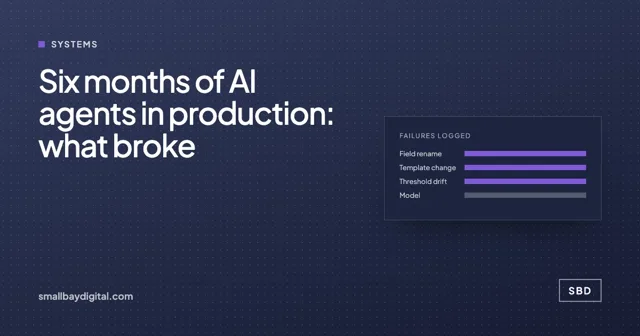
Agents break for ordinary reasons: a field is renamed, a supplier changes a document layout, a confidence threshold drifts. Our write-up of six months of agents in production lists what failed, and it was rarely the model. Budget monthly upkeep. As one example, SBD’s care plans start at $50, $150 and $300 a month by tier.
What drives the cost
- Autonomy. An agent that only suggests is cheap to make safe. One that writes to systems, sends messages or moves money needs approvals, limits and logging. Our post on how much an agent should be allowed to do sets out the rule we use.
- Number of tools and integrations. Each tool needs authentication, scoped permissions, error handling and tests.
- Data quality. Clean records keep runs short. Messy inputs mean longer prompts, more retries and more escalations.
- Guardrails. Spend caps, allow lists, input checks against prompt injection and approval steps all take build time.
- Evaluation. A good test set of real cases is the main thing that lets you change the agent later without fear. It is work up front.
- Who sees the output. Internal drafts can tolerate the odd mistake, customer-facing replies cannot, and real-time voice adds speed constraints on top.
Hidden costs
- Long and unusual inputs. A 40-page contract uses many times the tokens of an average email. Price the longest case as well as the average.
- Retries and loops. A failed tool call or an agent that keeps trying repeats every call in the run.
- Context growth. Each extra step resends the history, so a ten-step run costs more than twice a five-step one.
- Model changes. A new model version can change behaviour. Re-running your evaluation set takes time each time.
- Your team’s time. Writing down rules, labelling examples, testing and changing how people work.
- Accounts in someone else’s name. If the model and platform accounts sit with your supplier, leaving them means rebuilding.
1. Write down the job and the limits
Name the one job, the tools the agent may use, what it may change on its own and what needs a person’s approval. The free agent risk tool helps you decide where those lines sit, and our guide to putting an AI agent into production safely covers the controls in full.
2. Count runs and model calls
Take monthly volume from a system report. Then sketch one run and count model calls: planning, each tool call, each check, the final write.
3. Measure tokens on real examples
Run ten real cases through a prototype and record input and output tokens per call. Include the longest, messiest case you can find.
4. Price the tokens on two models
Apply the formula on a small model and a mid-sized one. If the small model passes your test cases, use it, or route only the hard cases to the larger one.
5. Add hosting, monitoring and review time
Add platform or hosting fees, any logging or evaluation tool, and the review hours multiplied by what those hours cost you.
6. Price the build and upkeep
Ask for a fixed price against a written scope, with evaluations, documentation and a period of fixes after launch included. Add monthly upkeep and 10% contingency. Then set the first year’s total against the time the agent saves in the free ROI calculator.
When an agent is the wrong answer
If the steps are the same every time, you do not need an agent. A rules-based automation that moves a form into a CRM, or posts an invoice once its fields are known, is cheaper to build, costs almost nothing in tokens, and is far easier to test. Often the right design is a plain workflow with one AI step in the middle, such as reading a document, and no agent deciding what to do next.
An agent earns its cost where the work needs reading, judgement and a choice between tools, at enough volume that the review time is less than doing the work by hand. If your numbers do not show that, a simpler build is the better choice.
Checklist
0 of 12 done
Ticks are saved in this browser only.
Sources
- AnthropicClaude pricing
- OpenAIAPI pricing
- SBDPricing
- SBDAI agents service
Questions
How much does it cost to build an AI agent?
SBD's agent builds start at $1,500 as workflow automation, $3,000 inside an internal tool, $5,000 as part of a multi-module system and $10,000 inside a product your customers use, with the fixed price set after the audit. Other suppliers price differently.
What does an AI agent cost to run each month?
Model tokens, hosting or platform fees, monitoring, the time people spend reviewing its work, and upkeep. Tokens are often the smallest line. In our worked example, 2,000 runs a month comes to about $120 on Claude Sonnet 5.5 at list price and about $6 on Claude Haiku 5.5.
Why does an agent use more tokens than a single AI step?
An agent calls the model several times per run: to plan, to call each tool, to read the result and to decide what next. Each call resends the instructions and the history so far, so input tokens grow with every step.
Is a cheaper model good enough?
Often, for classification, extraction and routing. Test the smaller model on your own examples before choosing. At current list prices, Claude Haiku 5.5 costs a twentieth of Sonnet 5.5 for short prompts.
When should we not build an agent?
When the steps are the same every time. A rules-based automation is cheaper to build, cheaper to run and easier to test. Use an agent only where the work needs reading, judgement or choosing between tools.