


















Automation platforms
Apify consultant: public web data delivered to your systems.
SBD builds Apify pipelines that collect public web data on a schedule, check it, and pass it to your CRM, sheet or database, for teams of 5 to 1,000 people. Workflow automation builds start at $1,500, with the fixed price set after a $500 Automation Audit that is credited to the build.
- Tool
- apify.com
- Usually paired with
- n8n, Google Sheets, Apollo, Axiom.ai
- Timeline
- Most builds live in 3 to 5 business days from scope
- Owned by
- You, with accounts, credentials and code in your name.
What we build on Apify
- Run ready-made Actors or write custom ones for a specific site
- Schedule collection and send results to a sheet or database
- Feed scraped data into lead enrichment workflows
- Check output and alert someone when a site changes
What we sync
Workflows we are asked for
- Apify lead data into n8n and a CRM
- Apify competitor price tracking in Google Sheets
- Apify job listing collection on a schedule
- Apify results filtered by an AI step
Documented in depth
Full write-ups of Apify integrations.
Often paired with
Tools Apify usually needs to talk to.
-

Apify and n8n
The automation platform we build most systems on: code where needed, visual where not, cloud or self-hosted.
-
Apify and Google Sheets
The spreadsheet most operations start in, and the one most integrations have to respect.
-

Apify and Apollo
Prospect database and sales engagement tool used by outbound sales teams.
-
Apify and Axiom.ai
A browser automation and web scraping tool, used to click, read and type through websites and portals that have no usable API.
What we build
What an Apify expert from SBD builds
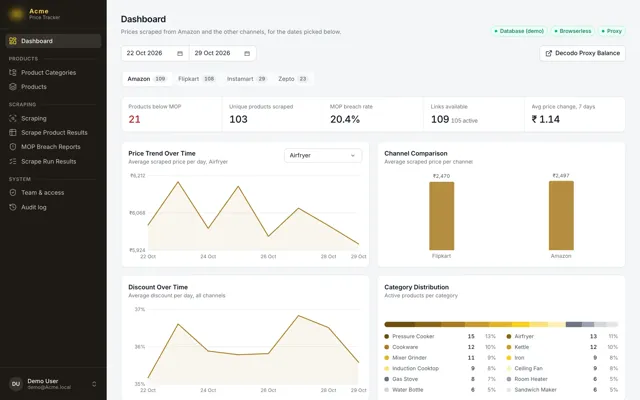
Sales, pricing and research teams often copy data out of websites by hand. Apify runs small programs called Actors in the cloud to collect that data, either from its store of ready-made Actors or from code written for one site.
Our published example is a lead enrichment system for a B2B sales team, where Apify sits alongside Apollo, Clearbit and BuiltWith in an n8n workflow, and qualified leads reach the CRM with tagged fields.
- Lead and company data collected and matched to CRM records.
- Competitor price and stock tracking on a schedule.
- Listings and directories turned into a clean table.
- Checks that alert someone when a site changes and results look wrong.
Fit
When Apify is the right choice, and when it is not
Apify suits repeatable collection from public pages at volume, with developers able to adjust an Actor when a site changes. For a logged-in portal that someone clicks through by hand, a bot in Axiom.ai may be simpler.
What you collect matters as much as how. Site terms and personal data rules decide what is appropriate, so we check both during scoping and say so if a source should be left out.
- The source offers an API or export; use that, because it breaks less often.
- The data is personal and you have no lawful basis to use it.
- You need it once; a one-off export may be cheaper than a pipeline.
Plans and limits
Apify plans and compute units
Apify combines a monthly plan with pay-as-you-go usage. Each plan includes prepaid credit for Apify Store and your own Actors, and one compute unit is 1 GB of RAM for an hour. Store Actors also have their own pricing, so a single run can cost very different amounts depending on the Actor.
From Apify's pricing page in November 2026, billed monthly:
- Free: $0; $5 of prepaid usage; $0.20 per compute unit; community support.
- Starter: $19 a month; $19 of prepaid usage; $0.20 per compute unit; chat support.
- Scale: $199 a month; $199 of prepaid usage; $0.16 per compute unit; priority chat support.
- Business: $999 a month; $999 of prepaid usage; $0.13 per compute unit; an account manager.
Engagement and cost
How hiring an Apify consultant from SBD works
Every engagement starts with an Automation Audit at $500, credited in full to your build. For Apify we review each source and its terms, look for an API first, test a sample run and estimate your monthly usage.
Workflow automation builds start at $1,500, and the fixed price is set after the audit and agreed before work begins. Your Apify subscription is paid by you to Apify. We do not resell licences.
Handover
What you own, and what happens when a site changes
The Apify account, any custom Actors and the destination systems stay in your name, with custom code in your repository. You receive a runbook covering each source, its schedule and what to do when it fails.
Sites change without warning, so every pipeline checks its own output. If the row count drops or a field goes empty, a named person is alerted before bad data reaches your team.
In every build
Standards we apply to every build.
Under the hood
- Upserts keyed on the record
Each write is matched on the source ID, so a retry or a re-fired event updates the existing record.
- Retries with backoff
Rate limits and timeouts are retried with increasing delays. If they still fail, they are parked for review.
- Idempotent, loop-safe writes
Two-way flows carry a marker so a change written by the sync does not re-trigger the sync.
- Reconciliation
A nightly job compares counts and totals on both sides and lists any record that differs.
- Audit log
Each run records the input, the mapping result, the action taken and what triggered it. You can search it by record.
For the team
- Slack or email notifications
Alerts go to a named person on your team, by Slack, email or WhatsApp.
- A runbook
One document per integration: what it does, what each alert means, and what to do in the first ten minutes.
- Training
A live session with the people who will use the review queue, recorded for whoever joins later.
- Handover
Admin access, billing and code sit in accounts in your name from the start, so the build keeps running if we stop working together.
- Sixty days of hypercare
The engineers who built it stay on call after go-live, fix what breaks and tune what the team asks for.
Keys and data
- Keys are kept in a vault
API keys and tokens are stored in the orchestration layer's encrypted credential store or the platform's secret manager. None are written into workflows, repos, spreadsheets or chat.
- One credential per connection
Each integration gets its own key, scoped to the objects and actions it needs. A lead sync cannot read invoices. Revoking one key stops one thing.
- Service accounts for connections
Connections use a dedicated service user in your account, so nothing breaks when a person leaves and nothing runs under someone's name.
- Two-factor on every account
Each platform account we set up has two-factor authentication on, and the recovery codes are handed to you.
- Rotation on handover and on request
Keys are rotated when the build is handed over, when anyone with access leaves, and at any time you ask.
The offer
Connect Apify to the rest of your stack.
We agree a fixed scope in a discovery call, and most builds go live in three to five business days. The accounts are in your name, and the engineers who built it stay on call for sixty days after.
- ScopeOne call to agree the workflows, the fields and the owner, written up the same day.
- BuildValidation, upserts, retries, reconciliation and an audit log, on n8n, Make or code.
- Go-liveWe test in a sandbox first, then switch over. It takes longer only where a vendor has to approve something.
- HandoverRunbook, training session, alerts to a named owner, admin access and code in your accounts.
- AfterSixty days of hypercare, then a care plan or run it yourself.
Questions
What people ask about Apify.
Apify or Axiom.ai?
Apify suits developers and repeatable collection at volume. Axiom.ai suits no-code bots that click and type through a site, including logged-in portals. We check site terms and personal data rules before using either.
Apify
Start with the one Apify workflow your team still runs by hand.
Bring it to a discovery call. You leave with a yes or no on fit, an outline of the build and what we would do first.
Book the call