Spreadsheets
Google Sheets automation: keep the sheet people like, fix what it cannot do
SBD builds Google Sheets automations that fill reports from your real systems, keep sheets in sync for people who will not leave them, and move sheets that turned into databases into something built for the job, for teams of 1 to 1,000 people. Workflow automation builds start at $1,000, with the fixed price set after a $500 Automation Audit that is credited to the build.
- Usually paired with
- Airtable, HubSpot, QuickBooks, Make
- Timeline
- Most builds live in 2 to 8 weeks
- Owned by
- You, with accounts, credentials and code in your name.
What we build on Google Sheets
- Use Sheets as a reporting layer fed from real systems
- Move a sheet that became a database into one
- Keep a sheet in sync for the people who will not leave it
- Trigger workflows from edits with validation
What we sync
Workflows we are asked for
- Google Sheets live reporting from CRM and accounting
- Google Sheets to Airtable migration
- Sheet edits to system updates with validation
- Weekly KPI sheet filled automatically
Full write-ups of Google Sheets integrations

Tools Google Sheets usually needs to talk to
-

Google Sheets and Airtable
A relational database with a spreadsheet face, used as the operations base for teams who have outgrown sheets.
-

Google Sheets and HubSpot
The CRM and marketing platform most B2B teams of 10 to 1,000 run on.
-
Google Sheets and QuickBooks
Intuit's accounting platform for small and mid-size companies, with an API that needs careful handling.
-

Google Sheets and Make
Visual automation with scenarios, routers and good error handling, formerly Integromat.
What a Google Sheets build from SBD does
Almost every operation we audit has a Google Sheet at its centre.
Sometimes that is fine: a sheet is the fastest way for a small team to see numbers and change them. Sometimes the sheet has quietly become the system of record for orders, stock or customers, with ten people editing it and nobody sure which column is right.
Our work covers three situations. Reporting: a sheet filled on a schedule from CRM, accounting and operations data, so the weekly numbers are there on Monday without anyone copying them. Sync: a sheet kept in step with a real database for the people who prefer the grid, with edits validated before they reach the system. Migration: a sheet that has become a database moved to Airtable, Supabase or Postgres, with the sheet kept as a view where it still helps.
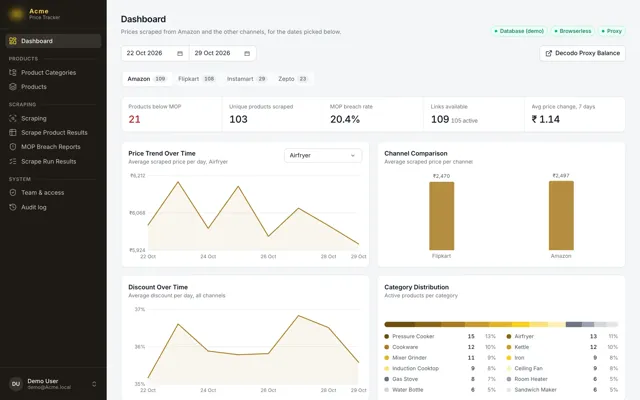
Two published SBD projects run on Sheets. For a five-person photo studio we built project and task management on Google Sheets with a Fillout enquiry form, Make for orchestration, and Google Apps Script and Cloudflare Workers taking the heavier processing to keep Make operation counts down; admin time fell by 60%. For an industrial manufacturer's QR cashback system, Sheets sits in the stack with Make, Cloudflare and Razorpay. And a marketplace price tracker now in build replaces a Google Sheet product master with a Postgres database.
Google Sheets as a database: where it stops
Google's help centre gives a spreadsheet limit of 20 million cells.
Most teams hit practical problems long before that. The Sheets API, per Google's limits page in October 2026, allows 300 read and 300 write requests a minute per project, and 60 of each per user per project. Google recommends payloads of 2 MB at most, and requests running longer than 180 seconds time out.
The structural problems matter more than the quotas:
- There are no stable row IDs. Sorting, filtering or inserting a row changes row numbers, so an integration that writes to "row 42" can overwrite the wrong record. We add an ID column and always look rows up by it.
- There are no types. A date can be text, a number can carry a space, and a dropdown can be overwritten by paste. Validation has to happen in the workflow as well as in the sheet.
- Concurrent edits are last-write-wins. Two people and an automation editing the same row produce silent conflicts.
- Permissions apply per file, so a sheet cannot show each salesperson only their own customers.
Apps Script, connectors and what each is good for
Google Apps Script runs inside Workspace and is often the cheapest way to do work close to the sheet
Its quotas, from Google's page in October 2026, are worth knowing: a script may run for 6 minutes per execution; triggers may run for 90 minutes a day in total on a consumer account and 6 hours on a Workspace account; there are 20 triggers per user per script; and URL Fetch is capped at 20,000 calls a day on consumer accounts and 100,000 on Workspace.
Make, Zapier and n8n all have Sheets modules that suit low-volume row triggers
For higher volume we write in batches through the API with backoff on errors, as Google recommends, and use Apps Script for in-sheet work such as formatting, protected ranges and custom menus. The photo studio build used exactly that split to keep its running cost close to zero.
The test we apply is simple
If the sheet is read by people and written by systems, keep it. If people and systems both write to it, and the data drives orders, stock or money, it is a database and should move into one, with the sheet kept as a read-only view. Our comparison of Airtable and Supabase covers where it should go.
How we build reporting sheets that stay correct
- 01
A reporting sheet fed by automation has a simple layout that we use every time.
A raw data tab is written only by the workflow, in batches, with a run timestamp in a fixed cell. Presentation tabs read from the raw tab with formulas and are where people look. The raw tab is protected so nobody pastes over it, and a check compares row counts and totals with the source after each run.
- 02
That separation means people can add their own charts and notes on the presentation tabs without breaking the feed, and the feed can be rebuilt without touching their work. If a run fails, the timestamp stops moving and an alert goes out, so nobody presents last week's numbers as this week's by mistake.
- 03
Writes go in one batch request per tab where possible, which keeps well inside the Sheets API's per-minute quotas even for large reports.
- 04
Sharing follows the data.
If a report includes margins or salaries, it goes in its own file shared only with the people who should see it, because Sheets permissions apply to the whole file and a hidden tab is not a security control.
How a Google Sheets engagement with SBD works
- Step 1$500Automation AuditCredited to the build
- Step 2from$1,000Workflow automationFixed after the audit
- Step 3from$3,000Internal toolsFixed after the audit
- Step 4from$50Care planA month, after sixty days of hypercare
Every engagement starts with an Automation Audit at $500, credited in full to your build. We map which sheets matter, who edits them, which systems copy into or out of them, and where errors come from. The audit says plainly whether a sheet should stay a sheet.
Workflow automation builds start at $1,000, internal tools at $3,000 and multi-module systems at $5,000. A reporting sheet fed from live systems is usually a workflow build; a migration with a new front end is usually an internal tool. Work runs in two-week sprints with sixty days of hypercare, and care plans start at $50 a month. See the pricing page.
What you own, and moving out of a sheet
Everything below is in your name when the build ends.
- The sheets, scripts, Google Cloud project and workflow platform are in your Workspace.
- You receive a list of sheets that automations read or write, the ID column and ranges each one depends on, the scripts and their triggers, and a runbook for failures.
- When a sheet moves to a database, we freeze the structure, clean duplicates and inconsistent values, load a copy, compare totals with the original, then cut over with a short edit freeze.
- Where people still want the grid, the sheet becomes a view refreshed from the database, so nobody loses the screen they know.
Google Sheets at enterprise scale
In larger organisations Google Sheets is used everywhere by finance, operations, sales operations and project teams, usually as a reporting and planning layer beside systems of record. The risk grows when an important process ends up running on a sheet that one person built and nobody owns.
Know which sheets matter
We inventory the sheets that automations read or write, record the owner of each, and flag any that act as a system of record for orders, stock or money.
Access control
Sheets share per file, so sensitive data is split into separate files or moved to a database with row-level rules. Automations use a dedicated account rather than a person's.
Quota-aware integrations
Writes are batched and paced within Sheets API quotas, with exponential backoff, and long jobs run outside Apps Script's 6-minute execution limit.
Data quality
Every write is validated in the workflow, rows are matched by an ID column, and protected ranges stop people overwriting columns that systems own.
A path off the sheet
Where a sheet has become a database, we migrate it to Airtable, Supabase or Postgres and keep a refreshed view for the people who want the grid.
Engagements we take on
Already on Sheets, weekly reports built by hand
Someone spends Monday morning copying exports. We fill the report from CRM, accounting and operations data on a schedule, with a timestamp and a check that totals match.
Already on Sheets, the order sheet has become the system
Ten people edit it and errors reach customers. We move orders into a database with a proper form and keep a read-only sheet view for those who want it.
Already on Sheets, a script nobody understands
An Apps Script written years ago runs a critical step. We document it, add error alerts, and decide with you whether to keep, rewrite or replace it.
Read next
Sources
- Google for Developers, Google Sheets API usage limits (read and write quotas, payload, timeout, backoff), checked 29 October 2026
- Google Drive Help, Files you can store in Google Drive (20 million cell limit), checked 29 October 2026
- Google for Developers, Apps Script quotas (runtime, triggers, URL Fetch), checked 29 October 2026
Standards on every build
Validation, retries, reconciliation, audit logs and alerts come as standard, with credentials and accounts in your name. Read the integration standards
What people ask about Google Sheets
Should the sheet stay the master record?
Rarely. It can stay as the view people like, fed from a system that enforces keys and types. The sheet stops being where data is typed.
Start with the one Google Sheets workflow your team still runs by hand
Bring it to a discovery call. You leave with a yes or no on fit, an outline of the build and what we would do first.
Book the call