












CRM and sales
Clay consultant: an outbound stack with Apollo and Instantly.
Clay enriches and scores lists, Apollo supplies contacts and sequences, and Instantly sends the email. SBD works with B2B sales teams to connect them to the CRM, keep one suppression list across all of them and write down the sending rules before a campaign starts, for teams of 5 to 1,000 people.
- Tool
- clay.com
- Usually paired with
- HubSpot, Salesforce, n8n, Make
- Timeline
- Most builds live in 3 to 5 business days from scope
- Owned by
- You, with accounts, credentials and code in your name.
What we build on Clay
- Build enrichment tables with your customer profile as the filter
- Connect Apollo, Instantly and your CRM
- Keep one suppression list across every sending tool
- Check domains, opt-outs and sending rules before a campaign
What we sync
Workflows we are asked for
- Clay enrichment to HubSpot with deduplication
- Apollo list to Clay to Instantly campaign
- Instantly reply to a named salesperson in the CRM
- Opt-out in Instantly to a shared suppression list
Often paired with
Tools Clay usually needs to talk to.
-
Clay and HubSpot
The CRM and marketing platform most B2B teams of 10 to 1,000 run on.
-

Clay and Salesforce
The enterprise CRM, with a broad API that needs careful design.
-
Clay and n8n
The automation platform we build most systems on: code where needed, visual where not, cloud or self-hosted.
-

Clay and Make
Visual automation with scenarios, routers and good error handling, formerly Integromat.
What we do
What SBD would build on an outbound stack
A common setup runs in a line. A list is built in Apollo or Clay, enriched and checked against your customer profile, then pushed to Instantly for sending. Replies come back by webhook, get classified and reach a named salesperson in HubSpot or your CRM with the context attached. Opt-outs and bounces go to one suppression list that every tool reads before sending.
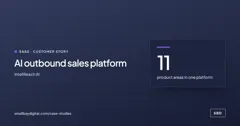
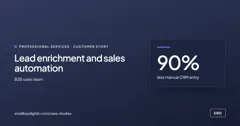
SBD has no published case study on Clay. We have published related work with the other two tools: lead capture, enrichment and CRM sync for a B2B sales team used Apollo for enrichment alongside Clearbit, BuiltWith and Apify, and the IntellReach AI outbound platform has Instantly in its stack, with address verification, reply handling and readiness checks before a campaign. We can show you those, and we will prototype your Clay table first so you see the results and the credit use.
Consent and sending rules
The consent and sending rules we work to
We settle this before any list is built, and your legal adviser has the final word, since we are not lawyers. These rules differ by the country of the person receiving the email, so we ask where your prospects are first.
In the US, the FTC's CAN-SPAM guidance, read in November 2026, requires accurate header information and a valid postal address in each message, and opt-outs honoured within 10 business days. The opt-out has to keep working for at least 30 days after sending, and each violating email can carry a penalty of up to $53,088.
In the UK, the ICO's guidance, read in November 2026, says you can email corporate bodies without prior consent if you identify yourself and give a valid opt-out address. Sole traders and some partnerships count as individuals, so they need consent unless the soft opt-in applies, and you cannot tell which is which from an email address. If in doubt, the ICO says to treat the address as an individual's, and UK GDPR still applies to a named person's details.
In the EU, the European Commission lists an address like name.surname@company.com as personal data and info@company.com as not personal data. So enrichment data about a named person needs a lawful basis and a record of where it came from, and national email marketing rules apply on top.
Mailbox providers set their own rules. Google's sender guidelines, read in November 2026, require SPF or DKIM, TLS and a reported spam rate below 0.3% for all senders. Anyone sending more than 5,000 messages a day also needs SPF, DKIM and DMARC, and marketing messages need one-click unsubscribe and a visible unsubscribe link.
Here is what that means for a build from us:
- Each contact record keeps its source and the date it was collected.
- A single suppression list is checked by every sending tool, and an opt-out in one tool updates it.
- Each message states who is sending it and includes a working opt-out and your postal address.
- Sending runs from a domain you own, with SPF, DKIM and DMARC checked before the first campaign.
- Messages are written to a real audience with a reason to hear from you, and volume rises only while spam and bounce rates stay low.
- We turn down lists of unknown origin, and work meant to disguise the sender or evade a provider's filters.
Plans and limits
Clay, Apollo and Instantly costs and limits
Clay's pricing page, read in November 2026, charges in actions and data credits. Actions measure platform use and reset each cycle, and data credits pay for marketplace data, starting at $0.05 each. Free includes 500 actions and 100 data credits a month. The page showed Launch at $167 a month in its plan header and $185 in its FAQ, and Growth at $446 and $495, so we confirm your price with Clay. CRM auto-sync, HTTP API integrations and webhook signals are listed on Growth, so the sync described above needs Growth or a workaround. SSO, role-based access and custom data processing terms are on Enterprise.
Apollo's pricing page, read in November 2026, lists Free, Basic, Professional and Custom plans with no dollar figures in the version we could read. Credits are pooled across the team, reset each billing cycle and do not roll over, and annual plans carry a 12-month commitment. Its API documentation recommends scoped keys limited to the endpoints an integration needs.
Instantly's pricing page, read in November 2026, lists its Outreach Growth plan at $47 a month for 5,000 emails and 1,000 uploaded contacts, with higher tiers shown at conflicting prices across the page, and credits for its lead database sold separately. Its API uses bearer keys with scopes, and webhooks report campaign, email, lead and meeting events. Unlimited sending accounts on a plan do not change any of the rules above.
Choosing tools
When this stack is the right choice, and when it is not
It suits a B2B team with a defined customer profile, a CRM someone keeps clean, and an offer that makes sense in a short email. Clay earns its cost when you need several data sources and logic across them for each prospect.
It is the wrong purchase in these cases:
- Most of your sales come from referrals or inbound. Fix how fast you reply to leads first.
- Your contacts are mainly consumers or sole traders in countries where consent is required.
- Your list and fields are simple. Apollo alone may cover enrichment and sequences, with no Clay subscription.
- Nobody will read replies. A person has to follow up, or the system only produces complaints.
Engagement and cost
How an outbound engagement with SBD works
Every engagement starts with an Automation Audit at $500, credited in full to your build. We map the countries you sell to, your data sources and your CRM, then agree the sending rules in writing. Workflows start at $1,500 and multi-module systems at $5,000, as a fixed price set after the audit. Tool accounts, domains and contact data stay in your name.
Read next
Sources
- Clay, Pricing (actions, data credits, plan features; page shows two prices per plan), checked 2 November 2026
- Apollo, Pricing (plans, credits, billing), checked 2 November 2026
- Apollo Docs, Create an API key (scoped and master keys), checked 2 November 2026
- Instantly, Pricing (Outreach and credit plans), checked 2 November 2026
- Instantly, Developer documentation (API v2, scopes, webhooks), checked 2 November 2026
- US FTC, CAN-SPAM Act compliance guide for business, checked 2 November 2026
- UK ICO, Business-to-business marketing, checked 2 November 2026
- European Commission, Data protection explained (examples of personal data), checked 2 November 2026
- Google, Email sender guidelines (all senders and bulk senders), checked 2 November 2026
In every build
Standards we apply to every build.
Under the hood
- Upserts keyed on the record
Each write is matched on the source ID, so a retry or a re-fired event updates the existing record.
- Retries with backoff
Rate limits and timeouts are retried with increasing delays. If they still fail, they are parked for review.
- Idempotent, loop-safe writes
Two-way flows carry a marker so a change written by the sync does not re-trigger the sync.
- Reconciliation
A nightly job compares counts and totals on both sides and lists any record that differs.
- Audit log
Each run records the input, the mapping result, the action taken and what triggered it. You can search it by record.
For the team
- Slack or email notifications
Alerts go to a named person on your team, by Slack, email or WhatsApp.
- A runbook
One document per integration: what it does, what each alert means, and what to do in the first ten minutes.
- Training
A live session with the people who will use the review queue, recorded for whoever joins later.
- Handover
Admin access, billing and code sit in accounts in your name from the start, so the build keeps running if we stop working together.
- Sixty days of hypercare
The engineers who built it stay on call after go-live, fix what breaks and tune what the team asks for.
Keys and data
- Keys are kept in a vault
API keys and tokens are stored in the orchestration layer's encrypted credential store or the platform's secret manager. None are written into workflows, repos, spreadsheets or chat.
- One credential per connection
Each integration gets its own key, scoped to the objects and actions it needs. A lead sync cannot read invoices. Revoking one key stops one thing.
- Service accounts for connections
Connections use a dedicated service user in your account, so nothing breaks when a person leaves and nothing runs under someone's name.
- Two-factor on every account
Each platform account we set up has two-factor authentication on, and the recovery codes are handed to you.
- Rotation on handover and on request
Keys are rotated when the build is handed over, when anyone with access leaves, and at any time you ask.
The offer
Connect Clay to the rest of your stack.
We agree a fixed scope in a discovery call, and most builds go live in three to five business days. The accounts are in your name, and the engineers who built it stay on call for sixty days after.
- ScopeOne call to agree the workflows, the fields and the owner, written up the same day.
- BuildValidation, upserts, retries, reconciliation and an audit log, on n8n, Make or code.
- Go-liveWe test in a sandbox first, then switch over. It takes longer only where a vendor has to approve something.
- HandoverRunbook, training session, alerts to a named owner, admin access and code in your accounts.
- AfterSixty days of hypercare, then a care plan or run it yourself.
Questions
What people ask about Clay.
Is cold email legal?
It depends on where the recipient is and whether they are a company or an individual. We set out the rules for your countries at the start, and your legal adviser has the final word.
Do I need Clay as well as Apollo?
Often not. If your list and fields are simple, Apollo may cover enrichment and sequences alone. Clay earns its cost when each prospect needs several data sources and logic across them.
Clay
Start with the one Clay workflow your team still runs by hand.
Bring it to a discovery call. You leave with a yes or no on fit, an outline of the build and what we would do first.
Book the call