App builders
Client portals on Softr: built, secured and supported
SBD builds client portals on Softr for teams of 1 to 1,000 people, so customers and partners log in to see their own orders, files and status instead of asking by email. Workflow automation builds start at $1,000 and internal tools at $3,000, with the fixed price set after a $500 Automation Audit that is credited to the build.
- Tool
- softr.io
- Usually paired with
- Airtable, SmartSuite, Google Sheets, WhatsApp Business API
- Timeline
- Most builds live in 2 to 8 weeks
- Owned by
- You, with accounts, credentials and code in your name.
What we build on Softr
- Build client portals so customers stop asking by email
- Give partners a view of their own records only
- Add forms and actions that write back correctly
- Keep the portal fast by shaping the data behind it
What we sync
Workflows we are asked for
- Softr client portal on Airtable
- Retailer order portal with approved access
- Softr partner dashboard
- Softr forms to workflows
Tools Softr usually needs to talk to
-

Softr and Airtable
A relational database with a spreadsheet face, used as the operations base for teams who have outgrown sheets.
-

Softr and SmartSuite
A work management database in the Airtable family, with stronger permissions and views.
-
Softr and Google Sheets
The spreadsheet most operations start in, and the one most integrations have to respect.
-

Softr and WhatsApp Business API
The channel customers in most markets reply on, with templates, sessions and consent rules.
What a Softr agency like SBD builds
Softr is one of several ways we build portals.
As a client portal builder it is quick to stand up on data you already keep, most often a client portal with Airtable underneath, but also SmartSuite or Google Sheets. We choose it when the portal is mostly lists, detail pages and forms, and the data model already exists or can be fixed.
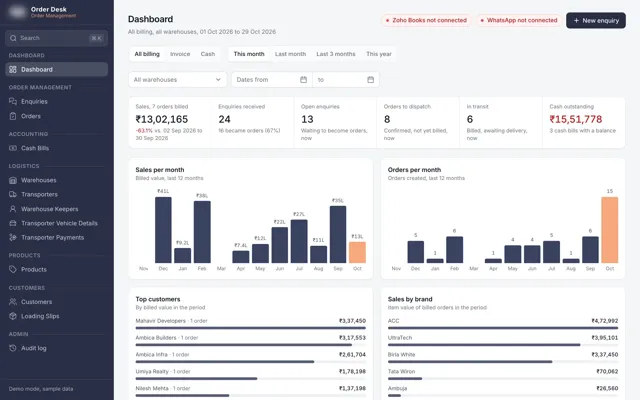
Typical portals let a client see the status of their jobs, download documents, approve a quote, raise a request and update their details. Partner portals show a retailer or agent only their own orders and commission. Behind the portal we connect forms to workflows in n8n or Make, so a request in Softr becomes a task, a message and a record update without anyone retyping it.
We have not yet published a case study built on Softr, so we will not point you to one. The closest published work is a gated retailer catalogue and order portal for a wholesale jeweller, which follows the same pattern of approved-only access, though it was built on Bubble.
When Softr is the right client portal builder, and when it is not
A good fit
Softr suits portals for tens or hundreds of external users over a base your team already runs. It handles login, user groups and page visibility, and its access rules can filter records by the logged-in user, which covers most "clients see only their own records" requirements. Your staff keep working in Airtable while clients work in the portal.
We will recommend something else when
- You expect thousands of client users; per-user caps make a custom app or Retool external apps worth pricing.
- Clients need complex, multi-step workflows or heavy calculations in the browser.
- The data underneath is a mess; we fix the base first, because a portal shows clients exactly what is there.
- Permissions must be enforced at database level for compliance; a Supabase app with row-level security is stricter.
Softr plans and app user limits
- 01
Softr counts app users in two kinds: team users inside your organisation and client users outside it.
Each paid plan includes a set number of each, with paid extras on the higher plans, and features such as custom domains, user groups and some data sources depend on the plan.
- 02
Prices and user caps change often, so we price your portal against Softr's current pricing page during the audit, using the number of clients you expect to log in over the next year. For portals with hundreds of client users, the per-user caps usually decide the plan more than the features do.
How a client portal build with SBD works, and what it costs
- Step 1$500Automation AuditCredited to the build
- Step 2from$1,000Workflow automationFixed after the audit
- Step 3from$3,000Internal toolsFixed after the audit
- Step 4from$50Care planA month, after sixty days of hypercare
Every engagement starts with an Automation Audit at $500, credited in full to your build. For a portal that means listing who logs in, what each kind of user should see and do, and how many users you expect in a year, so the plan is chosen on real numbers.
Workflow automation builds start at $1,000, internal tools at $3,000 and multi-module systems at $5,000, and the fixed price is set after the audit and agreed before work begins. A typical build covers the data model, the portal pages for each user group, access rules, forms that write back correctly and the workflows behind them. Before launch we log in as a second test client and confirm nothing from the first is visible. Work runs in two-week sprints and includes sixty days of hypercare. Care plans then start at $50 a month. Nothing is billed by the hour; see the pricing page.
Your Softr and Airtable subscriptions are paid by you, to each vendor.
What you own, and moving a portal off Softr later
Everything below is in your name when the build ends.
- The Softr workspace, the data source, the custom domain and every automation account are in your name.
- You receive a map of each user group and what it can see, a list of the access rules on every page, and a runbook for the workflows behind the forms.
- Because the data lives in your own base, the portal is a front end you can replace.
- If you outgrow the user caps or need stricter permissions, we move the data to Supabase and build the portal as an app, keeping the same pages and logins where we can.
- Most teams never need to.
- If a shared folder and a weekly email would serve your clients just as well, the audit will say so.
Softr at enterprise scale
Softr is used by larger organisations to put portals and internal apps on top of data they already hold, often in Airtable: client and partner portals, knowledge bases, request tools and lightweight internal systems. Softr's enterprise page lists SAML SSO for builders and app users, custom user groups, audit logs, multiple team spaces and SOC 2 Type 2 and GDPR compliance.
User groups and permissions
We design user groups and visibility rules for each page and block, test them as each type of user, and make sure data is filtered at the source as well as hidden in the interface, so a client or partner sees only their own records.
SSO and user provisioning
Where your plan includes SAML SSO, we connect builder and app sign-in to your identity provider and document how users are added and removed, including how client and partner users are handled outside your directory. Leavers lose access through your normal process.
Audit logs and security reviews
On the plan that provides audit logs, we agree which actions are reviewed and by whom. For questionnaires and DPAs about SBD's own work, see our trust centre and security page.
Data source and scale
We review the data source behind each app. When an Airtable base nears its limits or needs stronger access control, we move the data to a database Softr supports on your plan, such as Supabase, and rebuild the affected pages.
Team spaces and governance
We organise apps into team spaces, set naming rules, and keep a register of every app, its owner, data source and audience, so portals do not multiply without anyone knowing who maintains them. New apps follow a short template so they are documented from the start.
Training and handover
We train the people who maintain each app on editing pages, groups and permissions safely, and hand over written notes on what each app does and what to check after a change to the data source.
Engagements we take on
Already on Softr, need a client portal that passes a security review
Your portal works but the security team has questions. We review user groups, filters and data sources, close gaps where records could be seen by the wrong user, set up SSO where your plan allows, and document the access model for the reviewers.
Several Softr apps built by different teams
Marketing, operations and partnerships each built their own app. We map them, consolidate shared data, organise team spaces, apply standard naming and permissions and give each app an owner and documentation. Duplicate apps are retired once their users have moved.
Move a Softr app off an Airtable base that has outgrown it
Records or access rules have outgrown Airtable. We move the data to a database such as Supabase, keep the Softr front end your users know, and rebuild filters and permissions against the new source. Users are tested by group before switch-over, and the old base is kept read-only until you confirm the move.
Add workflows and AI to an existing Softr portal
Requests submitted through your portal need routing, approvals or AI summaries. We connect the portal to n8n or Make, add the AI step with a person approving anything uncertain, and send status updates back to the portal. Every step is logged so your team can see where a request is and why.
Read next
Sources
Standards on every build
Validation, retries, reconciliation, audit logs and alerts come as standard, with credentials and accounts in your name. Read the integration standards
What people ask about Softr
Can customers see only their records?
Yes. Access rules filter by the logged-in user's linked record, and we test it with a second account before launch.
Start with the one Softr workflow your team still runs by hand
Bring it to a discovery call. You leave with a yes or no on fit, an outline of the build and what we would do first.
Book the call