

















For Shopify and marketplace sellers
Automation for sellers on Shopify, Amazon and eBay with accounts to keep in order.
Selling in more than one place means the same product is listed several times, stock is counted in several places and orders arrive from each channel in a different format. Off-the-shelf connectors cover part of it. We build the rest around your catalogue, so a change is made once and each channel and your accounts follow.
For founders and operations leads at e-commerce and D2C brands of 5 to 1,000 people selling on Shopify with at least one marketplace alongside.




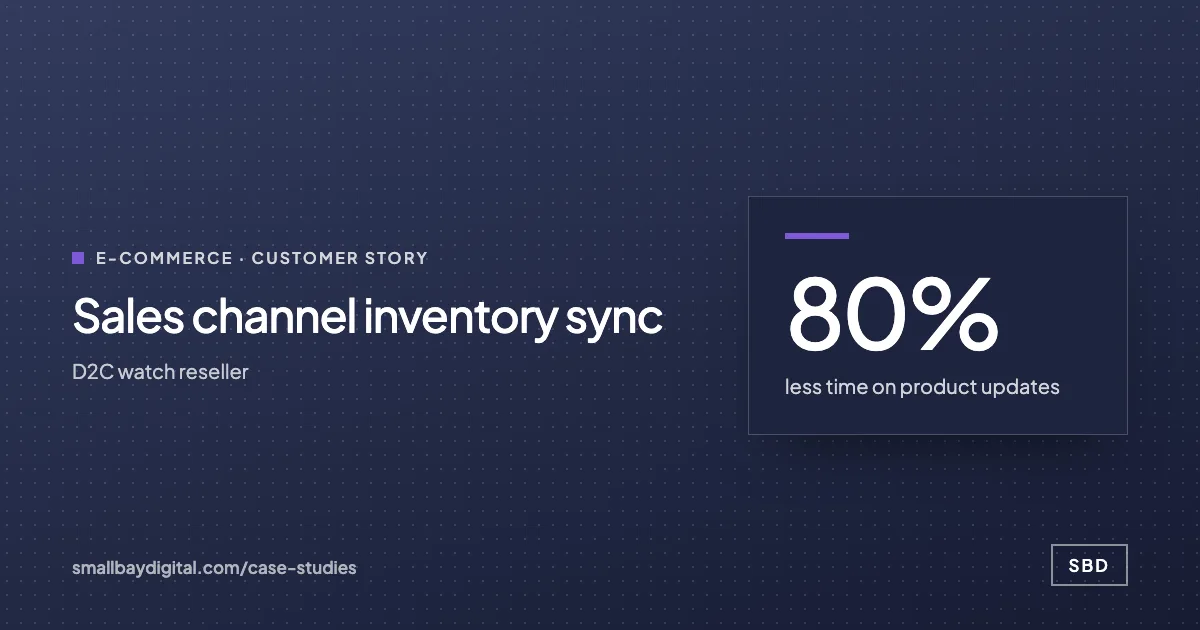
reported inventory mismatches in the 90 days after go-live, for a D2C watch reseller on Shopify and eBay
Read how it was measuredBefore and after
What changes in a normal week.
Today
- A new product is typed into Shopify, then again into each marketplace, with titles and prices drifting apart.
- An item sells on one channel and is still live on another until someone takes it down.
- Marketplace payouts arrive as lump sums that the accountant breaks apart by hand each month.
- Customer details sit in Shopify, in each marketplace and in the CRM, with no way to see one customer across them.
After the build
- Products are created and edited in one catalogue, and Shopify and the marketplaces are updated from it.
- Stock changes on any channel update the others within the sync window you agree.
- Orders and payouts are posted to QuickBooks, Xero or Zoho Books with fees and refunds split out.
- Buyers from each channel are matched into one customer record in the CRM.
What we build
The systems behind the change.
Built in your accounts, at a fixed price agreed after the audit. Builds start at $1,500.
- One product catalogue
A single table of products, variants and prices that publishes to Shopify and eBay, with channel-specific fields kept beside it.
- Stock sync across channels
Stock levels pushed to each channel on every sale and restock, with a daily check that flags any mismatch.

- Sales into the accounts
Orders, fees, refunds and payouts posted to your accounting system so the month end reconciles from records.

- Customer records in the CRM
Buyers across channels matched into HubSpot for repeat-purchase and support history.
Proof
A team that has already made the change.
How it starts
Three steps, each with a price.
- 01Discovery call
Thirty minutes on the work your team does by hand. Free, and you leave with a yes or no on fit.
- 02Automation Audit, $500
One to two weeks with the people who do the work. Each fix gets hours saved and a fixed price. Credited to the build.
- 03Build, from $1,500
Two-week sprints in your accounts, then 60 days of hypercare by the same engineers.
Questions
What people ask first.
Why not use a multichannel app from the Shopify store?
If one does what you need, use it, and we will say so in the audit. They tend to struggle with custom product data, bundles, or accounts in a specific shape, and that is the part we build.
Have you done this with Amazon?
Our published case study is Shopify with eBay. Amazon has its own API rules and approval steps, and we would scope those in the audit before quoting.
What happens during a sale or a launch when volume spikes?
We size the sync to your peak days and test against them before go-live. The 60 days of hypercare after launch usually covers at least one busy period.
Shopify and marketplaces
Bring one process your team still runs by hand.
On a discovery call we look at how it runs today and tell you what it would take to change it, with a price. The call is free.
Book a discovery call