














For COOs and operations managers
Enter each order once and let the next team pick it up from there.
Most operations teams retype the same order three or four times: from the email, into a sheet, into the ERP and onto the dispatch note. We connect those steps so the order is captured once and each handoff happens from the same record.
For operations leads at companies of 20 to 1,000 people where orders and jobs pass through several teams and systems.





faster order processing for a copper wire manufacturer
Read how it was measuredBefore and after
What changes in a normal week.
Today
- Sales forwards the order email and someone in operations keys it into a spreadsheet.
- Production, stores and dispatch each keep their own copy of the order and their own status.
- Handoffs happen in WhatsApp groups, so who did what is hard to trace afterwards.
- Monday meetings start with twenty minutes of reconciling whose numbers are right.
After the build
- The order is read from the email or form once and written to a single order record.
- Each team updates status on that record, and the next team is told when it is their turn.
- Handoffs are logged with a name and a time, so a delay can be traced to the step where it happened.
- The meeting opens on a dashboard everyone already agrees with.
What we build
The systems behind the change.
Built in your accounts, at a fixed price agreed after the audit. Builds start at $1,500.
- Order capture
Orders from email, forms or a portal read once and written into your ERP or order base, with unclear ones sent to a person to check.

- Stage handoffs
Status changes on the order trigger the next team’s task and a message to the person on shift.

- An operations dashboard
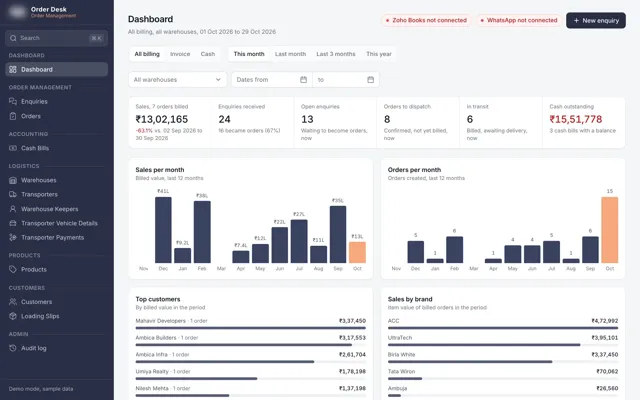
Open orders by stage, age and owner, refreshed from the live records so nobody builds it by hand.
Proof
A team that has already made the change.
-
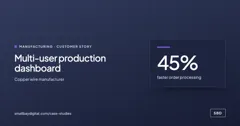
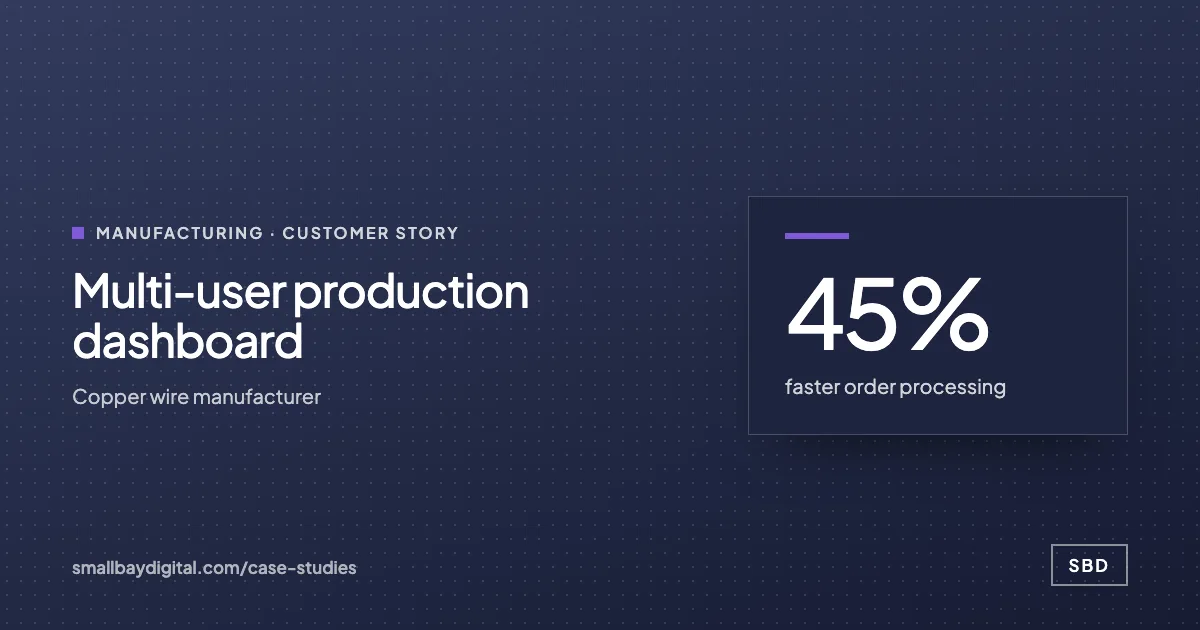 Copper wire manufacturer · Manufacturing Multi-user production dashboard 45%faster order processing60%better data accuracy10+modules in daily use Read the story
-
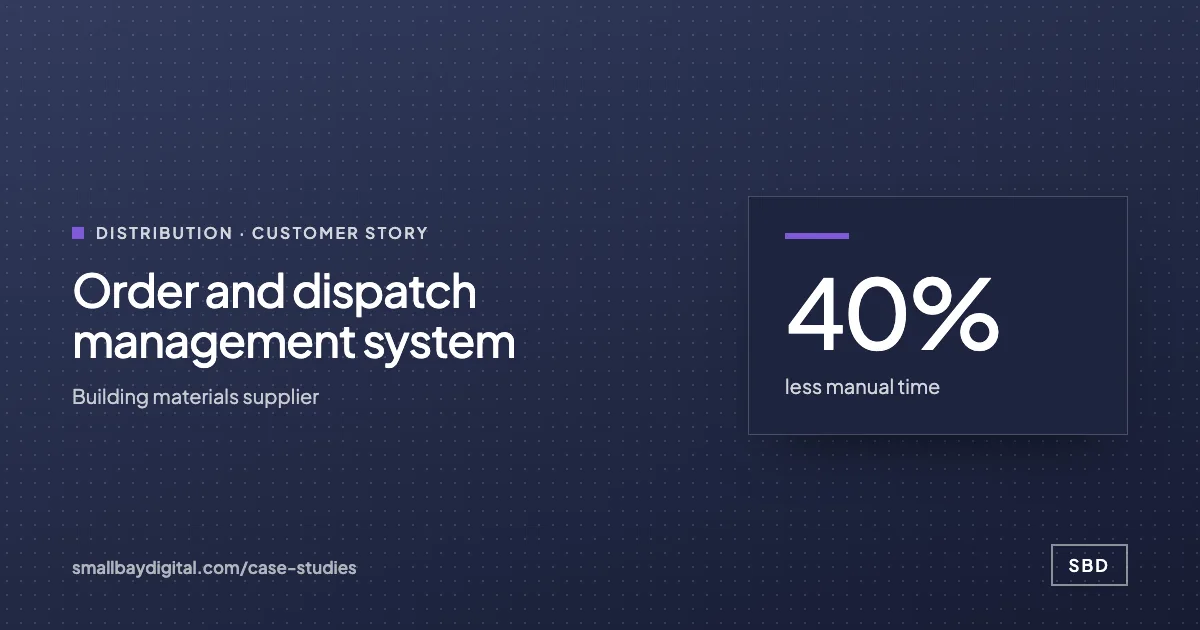 Building materials supplier · Distribution Order and dispatch management system 40%less manual time5+stakeholder types kept informedAutoinvoicing Read the story
How it starts
Three steps, each with a price.
- 01Discovery call
Thirty minutes on the work your team does by hand. Free, and you leave with a yes or no on fit.
- 02Automation Audit, $500
One to two weeks with the people who do the work. Each fix gets hours saved and a fixed price. Credited to the build.
- 03Build, from $1,500
Two-week sprints in your accounts, then 60 days of hypercare by the same engineers.
Questions
What people ask first.
Our process has exceptions everywhere. Can you automate that?
We automate the cases that follow the rules and route the rest to a named person with the details attached. The audit maps which is which before anything is priced.
Will my team have to stop work while you switch over?
No. We run the new flow alongside the old one on real orders until the numbers match, then switch over stage by stage.
What happens when something breaks after launch?
For 60 days after go-live we fix issues as part of the build. After that, care plans from $50 a month cover monitoring and fixes, and you get alerts when a run fails.
Operations leads
Bring one process your team still runs by hand.
On a discovery call we look at how it runs today and tell you what it would take to change it, with a price. The call is free.
Book a discovery call