


















Teams on SmartSuite
Connect SmartSuite to the tools around it so records stop being copied in and out.
SmartSuite sits in the Airtable family, with stronger permissions and views built for process work, which suits teams that care who can see and change what. Much of the time it saves is lost when records still have to be copied in from Shopify, the CRM or email and back out to the accounts. We design the schema, connect it, and tell you when a workspace has grown into something that needs its own app.
For operations leads at companies of 5 to 1,000 people who run products, orders, quotations or approvals in SmartSuite.



inventory mismatches across three sales channels with SmartSuite as the product record
Read how it was measuredBefore and after
What changes in a normal week.
Today
- Products are kept in SmartSuite and then updated again by hand on each sales channel.
- Orders from Shopify are copied into a SmartSuite solution so the team can work them.
- Approvals wait in someone’s notifications because nothing tells them a record needs them.
- The workspace has grown modules, shared logins and permissions set only in the interface.
After the build
- Changes to a product in SmartSuite are pushed to each channel in that channel’s format.
- New orders arrive in SmartSuite from the store with the customer and line items filled in.
- An approval request reaches the approver on WhatsApp or email with a link to the record.
- When the workspace is outgrown, its tables are mapped to a purpose-built tool with server-side roles.
What we build
The systems behind the change.
Built in your accounts, at a fixed price agreed after the audit. Builds start at $1,500.
- Solution design
Tables, keys and links set out as a schema before any automation touches them.
- Channel and order sync
Product records pushed to Shopify and eBay, with orders and stock synced back.

- Approvals with notifications
Role-based approval steps that message the approver and record who approved what.

- A move to a custom tool, when needed
A workspace that outgrew SmartSuite rebuilt on Next.js and Supabase, with the data migrated before switch-over.
N
Proof
A team that has already made the change.
-
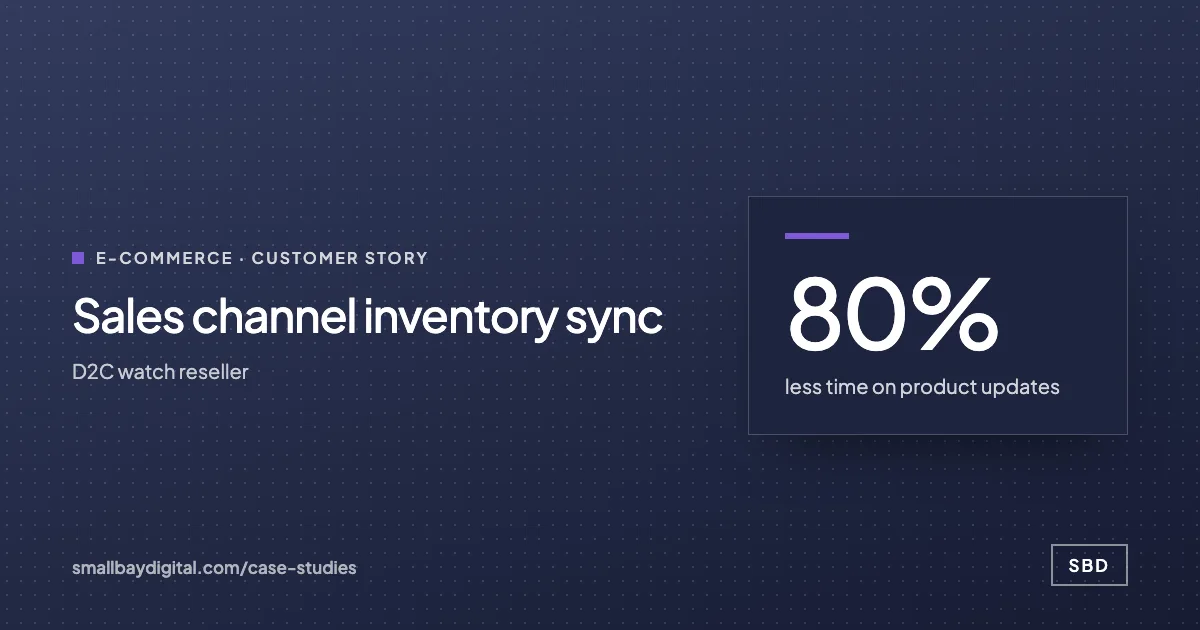 D2C watch reseller · E-commerce Sales channel inventory sync 80%less time on product updates0inventory mismatches2xfaster launches Read the story
-
 OneMagnate Consulting · Professional Services Internal operations tool replacing SmartSuite 9modules in one toolServerenforced roles0shared or demo logins Read the story
How it starts
Three steps, each with a price.
- 01Discovery call
Thirty minutes on the work your team does by hand. Free, and you leave with a yes or no on fit.
- 02Automation Audit, $500
One to two weeks with the people who do the work. Each fix gets hours saved and a fixed price. Credited to the build.
- 03Build, from $1,500
Two-week sprints in your accounts, then 60 days of hypercare by the same engineers.
Questions
What people ask first.
Should we move between SmartSuite and Airtable?
Rarely. A change of platform costs weeks and fixes little unless the problem is one the other tool handles better. Our comparison sets out where each is stronger.
Does SmartSuite connect to the tools we use?
Its native integration list is shorter than Airtable’s, so we connect it through its API with Make or n8n. We have linked it to Shopify, eBay and HubSpot this way.
How do we know when a workspace is outgrown?
When permissions set in the interface need to be enforced, logins are shared, and the modules have become a product of their own. That was the case for a consulting firm we moved onto a nine-module tool.
What does it cost?
A sync or approval flow starts at $1,500, a custom tool at $3,000 and a multi-module system at $5,000, each fixed after the $500 audit. Everything stays in your own SmartSuite and cloud accounts.
SmartSuite
Bring one process your team still runs by hand.
On a discovery call we look at how it runs today and tell you what it would take to change it, with a price. The call is free.
Book a discovery call